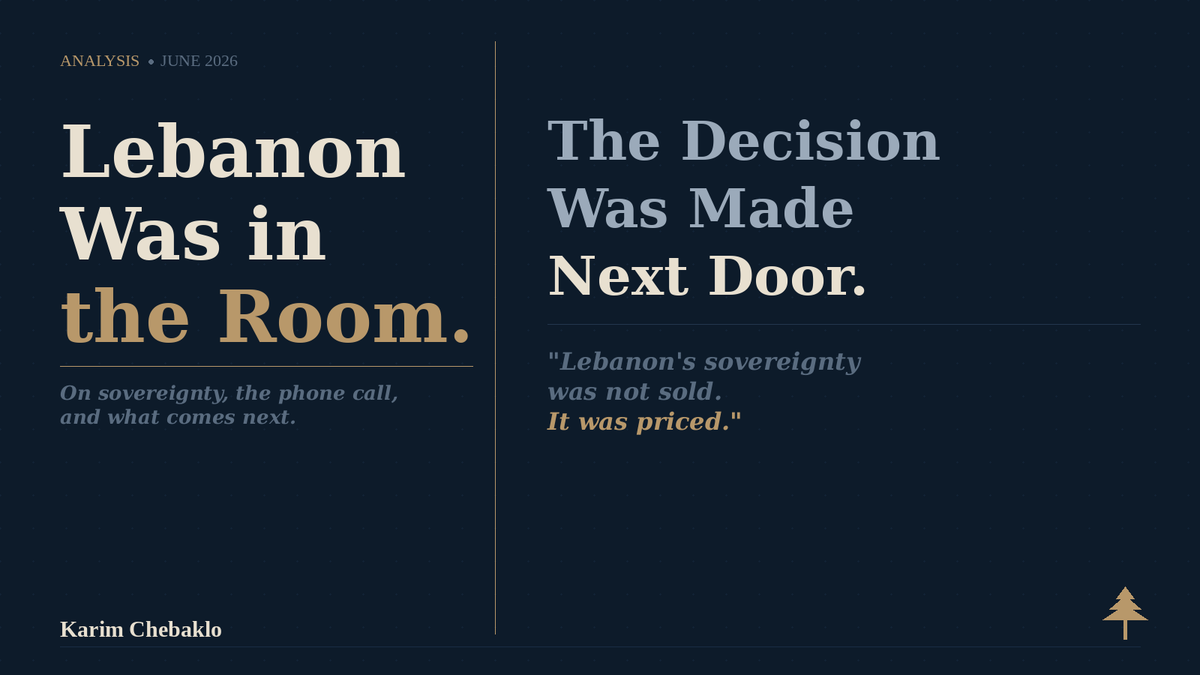
Lebanon Was in the Room. The Decision Was Made Next Door.
The morning after the US and Iran announced their memorandum of understanding, Lebanese President Joseph Aoun received a phone call. The caller was not the American president who had spent months building a sovereign Lebanon-Israel negotiating track. It was not the secretary of state whose department hosted four rounds of direct talks in Washington. It was Iran's Foreign Minister Abbas Araghchi, calling to brief the Lebanese head of state on the terms of a deal that included his country's territory.
That phone call is the whole story. Not who won. Not who lost. What it means when the president of a sovereign republic learns the terms of an agreement about his own land from a foreign minister whose government was not asked to respect Lebanese sovereignty, but to define it.
The State Did Everything Right
Let us be precise about what Lebanon actually achieved before drawing any conclusions, because fairness demands it and the argument requires it.
For the first time since the failure of the May 17 Agreement in 1983, the Lebanese state sat across from Israel in direct, open negotiations. Aoun and Salam broke a 43-year taboo. They paid a real domestic political cost for it. They produced a trilateral statement that placed the Lebanese Armed Forces as the sole authority over Lebanese territory and named every non-state actor as outside that monopoly. They showed up in Washington not once but four times.
That is not theater. That is the maximum achievable act of sovereignty for a state in Lebanon's condition. I argued that for months and I stand by it. You have to claim the monopoly before you can build it. A prime minister who says out loud that the state, not the party, decides Lebanon's war and peace is laying a marker, even if he cannot enforce it tonight.
The state did everything right. That is what makes what happened next so precise and so damaging.
The Price of Lebanon
The United States did not sell Lebanese sovereignty to Iran. That framing is wrong and too simple, and the reality is worse.
A sale is a deliberate transaction. What happened here is structural. Lebanon's sovereignty was priced, assigned a value relative to two things Washington wanted more urgently: an Iranian nuclear framework and a manageable exit from a war it had not fully controlled. When those two priorities converged into the MOU, Lebanon's sovereign track was not abandoned. It was subordinated. Kept alive as a parallel process, maintained as a narrative of legitimacy, but stripped of primacy the moment the bigger deal moved.
Washington insists the nuclear track and the Lebanon track are separate. The MOU pairs them anyway. The US told reporters the agreement was not conditioned on an Israeli withdrawal from Lebanese territory, while simultaneously envisioning a ceasefire that covers Lebanon. Both things cannot be true. The US is telling two different stories to two different audiences, and Lebanon sits inside the gap between them with no ability to resolve the contradiction.
This is Lebanon as instrument, not party. Not a prize to be won. A pressure mechanism to be adjusted. Iran used Lebanon as its most efficient lever to extract concessions from Washington on the nuclear file. Washington used Lebanon as its most available incentive to keep Iran at the table. Neither party was asked for Lebanon's permission. Neither needed it.
The Outcome Problem
Here is the specific damage, stated precisely.
The Lebanese state spent months building the political and legal case for Israeli withdrawal through direct negotiations. It paid the domestic price of sitting across from Israel. It produced binding language placing the LAF as the exclusive security authority in Lebanese territory. It was building, incrementally and at real cost, toward the same outcome that Iran's leverage track delivered in 72 hours.
Speaker Berri announced that the MOU includes a phased 60-day Israeli withdrawal from south Lebanon. The demand the Lebanese state was working toward was delivered by Iran. Same destination. Different vehicle. The state took the slow road with enormous political cost. Iran took the leverage road with the Strait of Hormuz as collateral.
In a region that reads power, not process, the credit goes to whoever delivered. That is not cynicism. That is how diplomatic precedent gets established. If Iran delivers for Lebanon twice, it becomes the party Washington calls when it needs Lebanon to move. The state track does not disappear. It becomes the junior channel.
This is sovereignty capture dressed as a favor.
The Four Voices and the One Question
When the trilateral Washington statement was signed, four voices rose against it. Naim Qassem. Esmail Qaani. Abbas Araghchi. Nabih Berri. I wrote at the time that only the Lebanese state had the standing to reject what the Lebanese state signed. Everyone else was entitled to an opinion. No one else was entitled to a veto.
That principle has not changed. What has changed is its practical weight.
Berri rejected the pilot zones. He declared Lebanon consists of 24 districts, not 24 pilot zones, and demanded full Israeli withdrawal in parallel with Hezbollah's pullback south of the Litani. Then the MOU arrived and embedded a version of exactly that demand, with American enforcement pressure behind it. Vance called Netanyahu and asked for a withdrawal plan. Netanyahu refused, but the ask happened. The US applied pressure on Israel over Lebanese territory not because Lebanon asked it to, but because Iran's leverage made it necessary.
Berri did not sabotage the state track. He ran a parallel track that produced the same outcome faster. The structural indictment is not that he worked against Lebanon. It is that the system allowed him to work around it and arrive first.
Why the Washington Talks Are Still Worth
The June 22 round in Washington should happen. But Lebanon needs to change what it is asking for inside it.
The current track is structured around Hezbollah disarmament as the central condition. That is the right long-term objective and the wrong immediate ask. Hezbollah disarmament cannot happen in 60 days. Asking for it now hands Hezbollah the ability to veto the entire process by simply not complying, and hands Iran another opportunity to deliver what Lebanon's state could not.
The Washington talks retain three things that exist nowhere else. First, the legal architecture. The language placing the LAF as the sole security authority over Lebanese territory, with no competing claim, was produced by the state-to-state track. It does not appear in the MOU. Without the Washington track, that language has no forum and no enforcement mechanism. Second, the pilot zones. Berri rejected them. Iran never included them. The only place they exist as a working concept is the Lebanon-Israel table. If those zones die, the LAF deployment dies with them. Third, the precedent of Lebanese authorship. Every agreement Lebanon signs for itself is a brick. Every agreement others sign for Lebanon is a debt.
What Lebanon should bring to June 22 is not the endgame. It is the next 30 days. Three specific, verifiable, time-bound asks: Israeli withdrawal from a defined first set of positions within 30 days tied to LAF deployment in those exact zones; a US commitment to treat any Israeli violation of that timeline as a breach of the MOU; and a written US acknowledgment that the Lebanon-Israel track is the primary mechanism for Lebanese sovereignty questions, not the Iran-US nuclear track.
If Lebanon walks in asking for those three things, the talks have real weight. If it walks in asking for full disarmament and full withdrawal with no sequencing, it gives Israel an excuse to stall and gives Iran another opportunity to outdeliver the state.
The Only Test That Matters
Sovereignty is not won when the firing stops. I have argued this from the beginning and the argument has not changed. It is won the day the state can take its territory and hold it on its own, without needing a foreign minister to brief its president on its own future.
The MOU gives Lebanon a 60-day window. That window is the only period where the Washington track can convert ceasefire into enforceable reality before the nuclear negotiations consume all American attention and Lebanon becomes, again, a variable to be adjusted.
The test is not whether the ceasefire holds. The test is who Washington calls first when it breaks. If it calls Beirut, the state track survived. If it calls Tehran, the phone call from Araghchi was not a courtesy.
It was a transfer of title.