The Real Battle for South Lebanon Will Be Fought With Checks
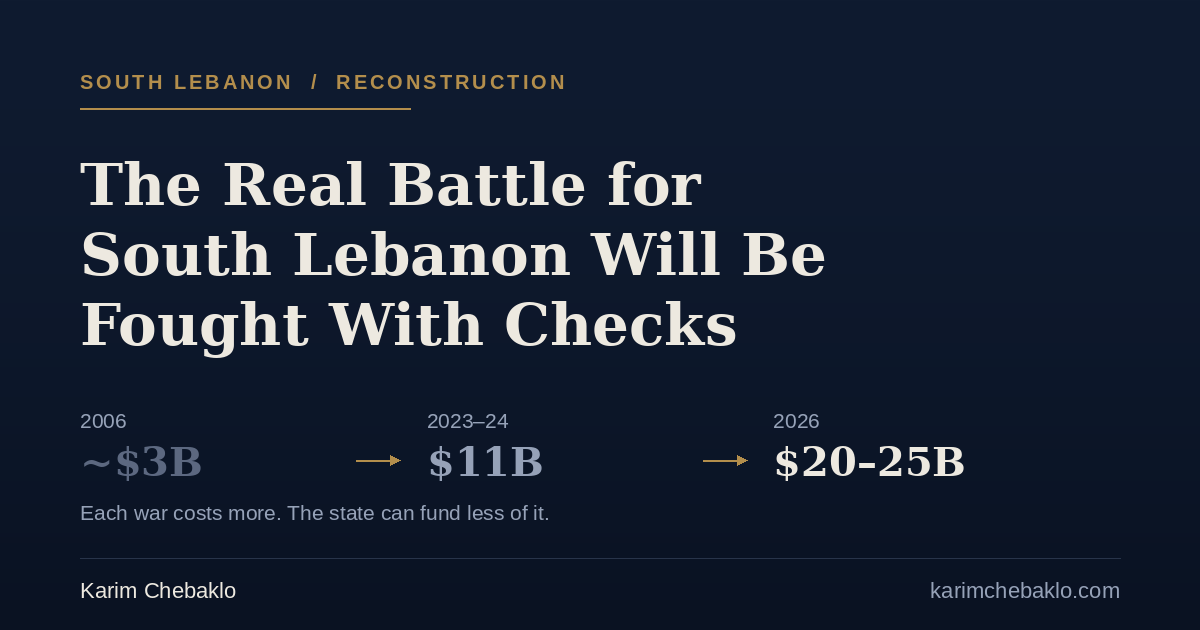
In 2006, the bill was $3 billion. Today it is past $20 billion. The fight over south Lebanon is moving to a front the state cannot afford to lose.
Lebanon is about to relearn a lesson it paid for in blood in 2006 and forgot by 2024. The fight over the south does not end when the shelling stops. It moves to a quieter front, where it is decided by who pays to rebuild, on what terms, and how fast.
Start with the numbers, because they are the argument.
In 2006, a thirty-three day war left a reconstruction bill of roughly three billion dollars. Gulf states and Iran covered most of it. Qatar adopted Bint Jbeil and Khiam. Iran, through Hezbollah, rebuilt faster than the Lebanese state could organize a committee. That speed was not charity. It was statecraft. Whoever hands a family the keys to a rebuilt home owns that family's politics for a generation.
After the 2023 to 2024 war, the World Bank put reconstruction and recovery needs at eleven billion dollars, against total damage and losses of fourteen billion. Of that eleven billion, the Bank estimated three to five billion would have to be publicly financed. Lebanon does not have it. The state is insolvent, the currency has lost most of its value, and the banking sector cannot intermediate capital. So the World Bank approved an initial two hundred and fifty million dollars to begin. Against an eleven billion dollar need, that is a down payment on a down payment.
Then came March 2026, and the last accounting became history.
Lebanon's own finance minister now puts the losses from the current war above twenty billion dollars, and warns the figure could climb toward twenty-five billion if the fighting continues. In the first thirty-five days alone, the National Council for Scientific Research counted around forty thousand housing units destroyed or damaged, more than a thousand a day. Israel's defence minister has been explicit about the intent, invoking the Gaza model of flattening border villages to remove threats near the frontier. This is not collateral damage. It is a deliberate program to make return impossible, carried out in part by private demolition contractors brought in to finish what the bombing started.
There is no consolidated final figure for this round yet, because the destruction has not stopped. But the direction is not in doubt. Each war costs more than the last. And each time, the Lebanese state can fund less of it.
That is the part the political class will not say out loud.
A state that cannot pay to bring its own citizens home cannot govern the territory they return to. This is the uncomfortable core of the sovereignty question, and it has nothing to do with how loudly anyone condemns Israel. Condemnation is free. Reconstruction is not. In 2006, the vacuum left by a slow and broke state was filled by Iran, and that single fact shaped southern politics for the next two decades. The vacuum today is wider, and the state is weaker.
Here is where the comfortable answer fails. The instinct is to say the solution is simple: make the Lebanese state the sole legal channel for reconstruction money, attach conditions, insist on transparency, and route everything through Beirut. That is necessary. It is also not sufficient, and pretending otherwise is how this gets lost.
Iran does not wait for the Lebanese state's permission. If a wider deal between Washington and Tehran unlocks Iranian funds, that money reaches Hezbollah and reconstruction begins on the ground regardless of what legal framework Beirut has drawn up. A legal monopoly the state cannot enforce is just paperwork, the same way the state's claimed monopoly on arms has been paperwork for years.
So the decisive lever is not in Beirut at all. It sits upstream, in the conditions attached to any agreement that releases Iranian money, and in the terms the Gulf and Western donors set on the funds only a sovereign state can receive. If sanctions relief flows to Tehran with no constraint on transfers to its proxy, Lebanon's reconstruction sovereignty is lost before the first check clears. If the large pools of legitimate capital, the money the Gulf and the multilaterals will only give to a state they can hold accountable, are mobilized under genuine state control, then the south can be rebuilt as Lebanon rather than as someone's constituency.
The state will not win a speed race against a patron handing out unconditioned cash. It cannot. Its only real advantage is scale and legitimacy: it is the sole entity that can unlock the billions that require a sovereign counterparty. That is the game it must play, and the place that game is decided is Washington and the Gulf capitals, not the villages of the south.
The arms are the visible front. The checks are the decisive one. Lebanon lost that fight in 2006 by default. It is about to fight it again, poorer, and this time the money may arrive before the state has even decided whether it intends to compete.
لبنان أولاً أو خسارة كل شيء