Lebanon Is Not Broke. It Just Acts Like It.
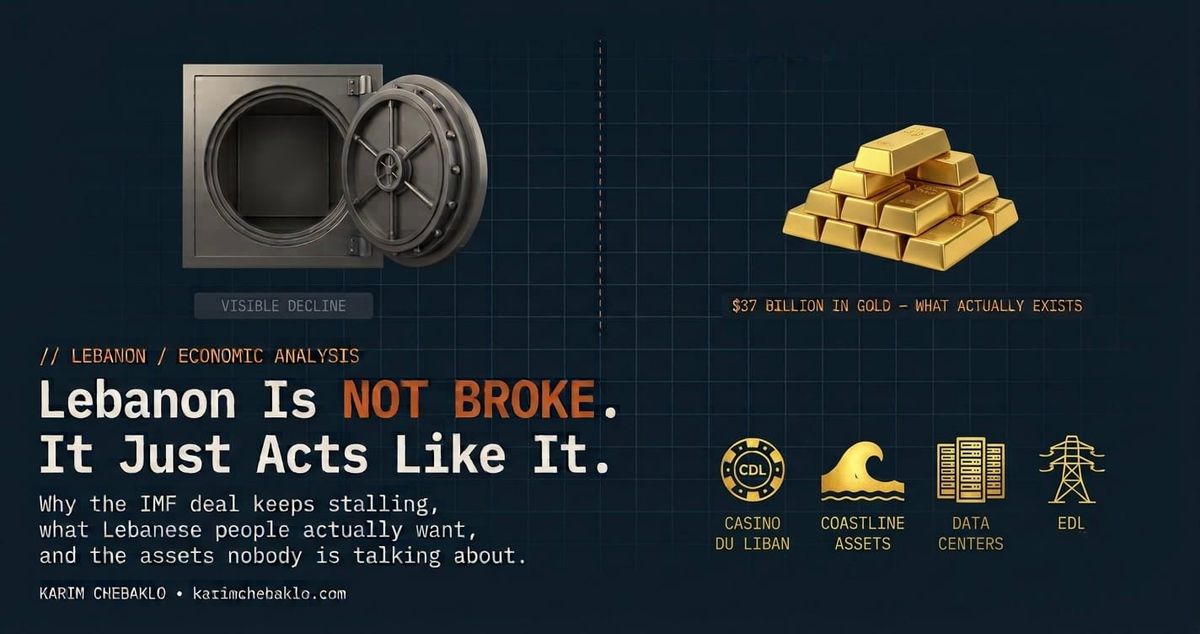
Why the IMF deal keeps stalling, what Lebanese people actually want, and the assets nobody is talking about.
The dinner was winding down. MPs, ministers, and diplomats were saying their goodbyes to the French ambassador, whose posting in Lebanon was ending. It was sunset in Faqra, Lebanon's mountain playground for the wealthy, where everyone has what they call a "chalet" for what is actually a mansion. The kind of evening that makes you forget what Beirut looks like after dark from up there: a city running on generators, its lights flickering on and off in patterns that depend on which neighborhood can afford how many hours of power, a state visible from the mountain but barely felt on the ground below.
Alia Moubayed, a Lebanese economist and Managing Director of Fixed Income and Emerging Markets Strategy at Jefferies International, pulled me aside. Six words.
"Lebanon is moving on borrowed time with borrowed money."
She didn't elaborate. The room full of MPs and ministers was the elaboration.
What Lebanese people actually want
My aunt spent thirty years teaching in an international school. Everyone who knows her knows the life she built: careful, disciplined, earned. By 2019 she had $150,000 saved. Not wealthy by any measure, but secure. Enough for her retirement, a life she had earned. Today she can access a fraction of it, in tranches, at terms she never agreed to, through a banking system that has never apologized for what it did to her.
She doesn't read IMF technical papers. She doesn't follow the Gap Law debate in parliament. She wants one thing: her money back. The money she earned, saved, and trusted to institutions that failed her.
Multiply her by a million accounts. That is what Lebanon's depositors actually want. Not a hierarchy of claims. Not a medium-term fiscal framework. Their money.
Everything else, every technical argument, every IMF condition, every parliamentary debate, is either a path toward giving it back or an obstacle to doing so. There is no third category.
What the IMF actually wants, in plain language
The IMF has been engaged with Lebanon since 2022. It has a $3 billion program on the table, conditional on reforms. In plain language, here is what it is asking for:
First, decide who absorbs the losses from the 2019 collapse. Lebanon's banks owe depositors approximately $82 billion. They have the assets to cover roughly $2 billion of it. That gap, around $80 billion, has to be assigned to someone: the state, Banque du Liban, and commercial banks. Assign the losses. Don't pretend they don't exist.
Second, wipe out bank shareholders immediately, before forensic audits are complete, on the grounds that the banks are clearly insolvent by any measure.
Third, keep the Lebanese state off the hook for contributing cash to the solution, because the state is already heavily indebted and adding more fiscal commitments would undermine debt sustainability.
Fourth, restructure the $31 billion in Eurobonds Lebanon defaulted on in 2020. No IMF program can close without a deal with bondholders.
Fifth, reform EDL, fix the budget, lift what remains of banking secrecy, strengthen anti-money laundering frameworks.
The IMF is not wrong about any of this in principle. The problem is the sequence and the logic of items two and three together. Wipe out bank shareholders now, before audits. And don't ask the state to pay its share. That combination means depositors absorb losses that belong partly to the state, while the state escapes accountability by claiming poverty.
This is what I have concluded from reading the numbers. Others may read them differently.
Lebanon is not broke. It acts like it.
Lebanon has assets. Real ones. Valuable ones. Ones that international operators would pay billions to access today. The reason those assets are not being monetized has nothing to do with capacity and everything to do with who currently benefits from keeping them exactly as they are.
Casino du Liban generated $194 million in annual revenue before the crisis and is the only licensed casino in Lebanon. A 30-year management concession to an international operator, structured competitively, would generate an estimated $3 billion upfront. It has not happened. Casino revenues flow through structures whose audit history has been repeatedly questioned, and privatization attempts have stalled every time they gained momentum.
Lebanese coastal land sits largely idle or illegally occupied under political protection. The appetite among Gulf and international developers for Mediterranean coastline is not theoretical. Qatar's sovereign wealth fund recently committed $29.7 billion to develop 7.2 kilometers of Egyptian Mediterranean coastline. The UAE committed $35 billion to Egypt's Ras Al Hikma on the same sea. A competitive concession program for Lebanese coastal land to serious international developers could generate $5 to $10 billion in immediate capital. The land exists. The demand exists across the region. The political will to remove the protection around it does not.
Electricite du Liban costs Lebanon over $1.5 billion annually in subsidies while delivering power for an average of a few hours a day. European and regional energy operators have at various points expressed interest in Lebanon's electricity sector. A structured concession to a serious operator, with the concessionaire responsible for infrastructure investment in exchange for long-term operating rights, removes the fiscal drain and generates upfront capital. EDL's dysfunction is not accidental. It is a patronage machine. Fixing it requires the political class to give up the patronage, which is why twenty years of privatization laws have produced exactly zero privatizations.
Lebanon's geographic position between Europe and the Gulf makes it a natural candidate for the data center infrastructure boom currently reshaping the region. Saudi Arabia, Egypt, and Morocco are signing billion-dollar deals with hyperscalers and sovereign wealth funds for data center zones. Lebanon has the submarine cable infrastructure, the geographic position, and the educated workforce. A state-backed technology zone offering long-term land concessions to international operators in exchange for upfront capital payments could generate $3 to $5 billion. The obstacle: data centers need reliable electricity. But an international operator would bring their own power infrastructure as part of the concession. That is how Egypt's data center zones work. Lebanon could do the same tomorrow if it wanted to.
Bekaa Valley agricultural land, much of it state-owned and currently leased below market value to politically connected operators, could generate recurring revenue through competitive leasing to serious agribusiness investors.
These are rough estimates, illustrative rather than precise, but the order of magnitude across all five categories is $16 to $28 billion over five to ten years. Not immediate. Not simple. But real.
And then there is the gold
Banque du Liban holds approximately 286.5 tons of gold, currently valued at approximately $37 billion. Lebanon ranks 19th in the world for gold reserves and second in the Middle East after Saudi Arabia. The gold reserve represents nearly 130% of Lebanese GDP, the highest such ratio in the world.
A bankrupt country does not hold $37 billion in gold. It holds $37 billion in gold and tells its depositors there is nothing left.
Law No. 42 of 1986 prohibits selling or using the gold. That law was passed by a parliament. It can be changed by a parliament. The same parliament that has not changed anything else in six years could change this tomorrow if it chose to.
There is a legitimate argument that pledging gold carries monetary risk, that it is the last credible backing for the currency and using it could undermine confidence at a moment when monetary stability is fragile. That argument deserves to be taken seriously. It is also an argument for how to use the gold carefully, not an argument for never touching it while depositors wait.
If the $80 billion gap is split three ways: the state covers its third through asset monetization, BdL covers its third by pledging or partially liquidating gold reserves in a structured, internationally supervised framework, and bank shareholders absorb the remainder after forensic audits establish the actual numbers. That is not a fantasy. It is arithmetic.
The IMF's objection is not that this is impossible. It is that Lebanon's state cannot be trusted to actually execute the asset monetization, and that waiting for forensic audits delays the bank restructuring indefinitely. Those are legitimate concerns. They are also an argument for sequencing and accountability mechanisms, not an argument for letting the state escape its share of the losses entirely.
Why none of this is happening
Alia Moubayed said "borrowed time with borrowed money." She was describing a clock. The clock is running because the people who could stop it benefit from letting it run.
Casino revenues flow through unaudited structures. Coastal land is politically protected. EDL's dysfunction is a patronage machine. The gold is legally untouchable by a law parliament could change. The Bekaa land is leased cheap to the connected. Every asset I have described is underutilized for the same reason: someone currently benefits from it staying exactly as it is, and that someone has enough political power to keep it that way.
This is not corruption in the petty sense. It is the system working as designed, as I described in a recent piece on Lebanon's political selection mechanism. The same filter that prevents reform candidates from accumulating power is the same filter preventing depositor recovery. They are the same problem.
PM Nawaf Salam said it himself at the World Economic Forum in Davos in January, standing in the snow, telling Reuters: "The longer we delay, the more people's money will evaporate."
He knows. The IMF knows. The depositors know.
The question is not whether the assets exist. They do. The question is not whether the math works. It does, roughly. The question is whether the political class will choose to monetize state assets and unlock depositor recovery before the borrowed time runs out.
History says no. The next twelve months will tell us if this time is different.
The dinner ended. The French ambassador said his final goodbyes. Beirut below flickered on, generator by generator, as it does every night. Alia Moubayed's six words followed me home.
Borrowed time. Borrowed money.
The clock is still running. The assets are still there.