Lebanon's Greatest Export Is Not Its Wine. It Is Its Children.
On the two bets Lebanese parents make, and what neither of them says about Lebanon's future.
I have been writing for months about Lebanon's recovery. About port governance and institutional reform. About the IMF and frozen deposits and the political system and what needs to change. I have argued, publicly and repeatedly, that things are moving in the right direction. That the state is reforming. That the country is worth betting on.
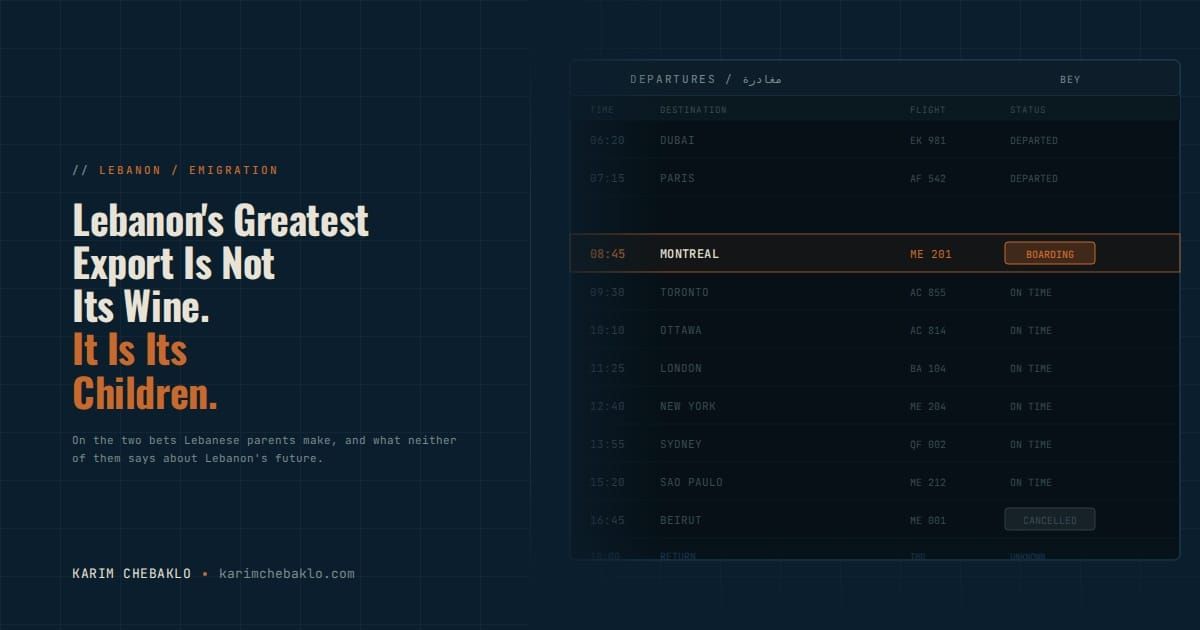
Last week I stood at Beirut airport and watched my second son board a plane to Montreal.
And I felt relieved.
Not sad. Not proud. Not conflicted. Relieved. The way you feel when something you were worried about is no longer your immediate problem. The way you feel when a risk has been removed.
I have been thinking about that relief ever since, because it tells me something about my own arguments that I am not entirely comfortable with.
The two models
Rayan is eighteen. He is going to study engineering in Montreal. His older brother Fouad is already in his third year of business law in Ottawa. Both of my sons are in Canada. Both left by choice, with my encouragement, with my relief.
At the airport, Rayan's friends came to say goodbye. Good kids. Smart, well-connected, from solid families. They hugged him, took photos, laughed the way eighteen-year-olds do when they are pretending a goodbye is not a goodbye. Some of them are staying in Beirut. Their parents made a different calculation than I did.
There are two models for raising a Lebanese child in 2026, and Lebanese parents argue about them the way they argue about everything: loudly, personally, and without resolution.
Model A is what I chose. Send them abroad. International education, international network, international perspective. The bet that a degree from a serious university in a functioning country gives them an advantage that no Lebanese institution can match right now. The bet that Lebanon will eventually be worth coming back to, and that they will come back better equipped to contribute to it. The bet that safety, for now, matters more than roots.
Model B is what Rayan's friends' parents chose. Keep them here. Let them learn the city, the system, the connections. Let them become fluent in how Lebanon actually works, not how it is supposed to work. Let them build the networks that only get built by being present, by navigating the dysfunction firsthand, by knowing which door to knock on and whose cousin to call. The bet that street intelligence inside a dysfunctional system is more valuable than a foreign degree, because the system will persist and knowing how to navigate it is a skill that cannot be taught in Montreal.
There is an assumption buried in Model B that is worth naming: that studying abroad is the expensive option. It is not always true. AUB, LAU, and USJ in Beirut charge tuition that rivals or exceeds international programs. France eliminates tuition almost entirely for Lebanese students under bilateral agreements. Canada, where my sons hold citizenship, charges nominal fees compared to private Lebanese universities. The street-smart local education, it turns out, often costs more than the international one.
Which leads to a conclusion that only Lebanon could produce: the Lebanese student is better financed abroad than at home. France subsidizes their education. Canada charges them almost nothing. Lebanon charges them full price for the privilege of studying in a country without reliable electricity, a functioning banking system, or a clear future.
Model B is not a financial calculation. It is a genuine bet that presence, network, and local knowledge are worth more than a foreign credential. That is a defensible position. It is just not the cheaper one. And it is certainly not the one Lebanon's own institutions are making easier to choose.
Both models are made by parents who love their children and want what is best for them. And both, if I am honest, are bets on a country that has not yet decided what it wants to be.
What the relief actually means
I have been trying to understand my own relief, because I do not think it is simply parental anxiety. I was anxious when Fouad left three years ago too. This was different. This was the specific relief of a risk removed.
Lebanon has a war in the south that has been grinding on for months. The banking crisis is unresolved. The deposits are frozen. A social gap is widening by the day: inflation is eroding what little purchasing power remains, the minimum wage cannot cover basic monthly costs, and the distance between those who earn in dollars and those who do not has become a fault line the country has not yet found a way to address. The political system, as I have written at length, was built to resist exactly the reforms that would make it worth staying in.
I believe all of this and I write about it publicly. And yet I also stand in front of audiences and argue that things are moving, that the institutions are reforming, that the port is different and BdL is different and the government under Prime Minister Nawaf Salam is more serious than anything we have seen since Taif.
Both of those things are true. And the relief at the airport is the place where they collide.
When I watched Rayan's plane disappear and felt relieved, I was not celebrating his escape from a hopeless country. I was feeling relief that he was safe from the specific, concrete risks of living in Lebanon right now. The war in the south. The uncertainty about what tomorrow brings. The daily friction of a state that still does not fully function despite everything that is improving.
The improvement is real. The risks are also real. And when it is your son on the plane, the risks feel more real than the improvement.
I write about Lebanon weekly at karimchebaklo.com. Subscribe free — one piece per week, no spam.
What Lebanon ends up with
Here is the question I could not stop thinking about at the airport, watching Rayan's friends wave goodbye.
Model A produces Lebanese who are educated, networked, and equipped. It also produces Lebanese who build lives abroad, fall in love abroad, find careers abroad, and come back to Beirut for August and Christmas if Lebanon is stable enough to visit. Some come back permanently. Most do not. I know this because I have watched it happen with my entire generation.
Model B produces Lebanese who know the system, know the people, know how to move through a dysfunctional state and extract value from it. It also produces Lebanese who are optimized for a system that may not survive. If Lebanon actually reforms, if the institutions actually change, if the state actually becomes functional, the skills that Model B builds become less valuable, not more. The street-smart networked kid loses his advantage the moment the street stops being the primary operating system.
Lebanon ends up with neither. Model A sends its best-prepared people to build their lives somewhere else. Model B keeps its most connected people in a system that is either collapsing or reforming, and either outcome makes their investment precarious.
We argue passionately about which model is correct, as if the destination were different. It is not. Both models are, in different ways, a response to the same underlying fact: Lebanon has not yet made itself a country where the obvious answer is to stay.
The bet
Rayan is in Montreal. Fouad is in Ottawa. I am in Beirut, writing about institutional reform and port governance and why Lebanon is worth betting on.
I believe what I write. I also felt relieved when my son's plane left.
Those two things are not a contradiction. They are a description of what it is to love a country that keeps making itself difficult to love. You believe in its future and you protect your children from its present. You argue for its reform and you send your sons abroad while the reform happens. You feel proud of the country at its best moments and relieved when the people you love most are safely outside it.
The friends who stayed in Beirut are not wrong. The sons who left are not right. We are all making bets with incomplete information on a country that has not yet decided what it is.
I just want Lebanon to decide before Rayan finishes his engineering degree.
He will be done in four years. If Lebanon hasn't decided by then, he will decide for it.