This Isn't Hypocrisy. It's Survival.
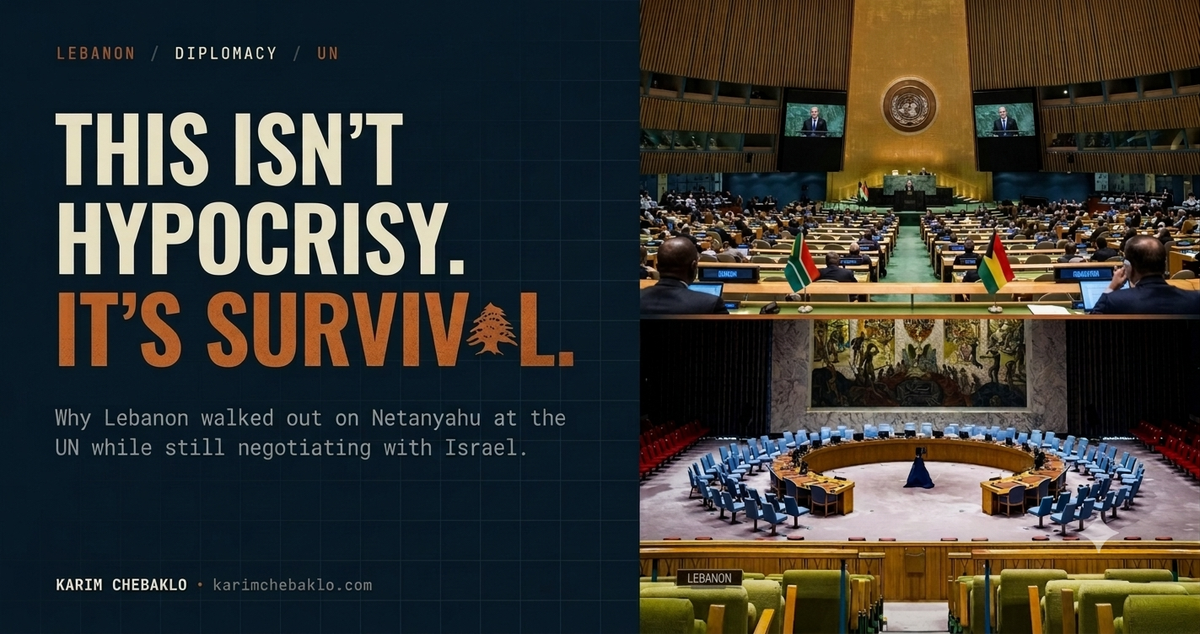
Why Lebanon walked out on Netanyahu at the UN while still negotiating with Israel
This week, Lebanon's delegation walked out of the UN General Assembly hall as Benjamin Netanyahu began speaking. Confusion followed almost immediately. Lebanon is in direct negotiations with Israel. Lebanon's own government has spent the past year arguing that the state, not Hezbollah, should hold a monopoly on weapons and end Iran's grip on Lebanese decision-making. So why walk out on the one leader whose government Lebanon is actually talking to?
The confusion comes from collapsing two different acts into one. Negotiating with an adversary is a security decision. Sitting in a room and applauding him is a political statement. Lebanon can do the first without doing the second.
Start with what Netanyahu did on that stage. He held up a pager. Not a metaphor, an actual pager, invoking the September 2024 operation in which thousands of booby-trapped devices detonated across Lebanon in a single afternoon. Hezbollah members were the intended targets. Civilians, medics, and children were among the dead and the roughly 4,000 wounded, in a country whose hospitals were already stretched past capacity. Netanyahu did not mention that toll. He held the device up like a trophy.
That is not a man extending an olive branch to a country he is simultaneously negotiating with. That is a man staging theater for a domestic and international audience, using Lebanese casualties as a prop. A Lebanese delegation sitting through that in silence, let alone applauding, would not have signaled maturity or diplomatic seriousness. It would have signaled that the government has no floor, that there is no line Israel can cross and still expect Lebanon to perform politeness.
Critics of the walkout ignore the domestic calculation, and it cuts against Hezbollah. Hezbollah's base is already primed to read any sign of normalization with Israel as proof that the state is capitulating on their behalf. Handing them a clip of Lebanese diplomats sitting quietly while Netanyahu waves a pager that killed Lebanese civilians would have been a gift. It would have let Hezbollah reframe a genuine negotiating track, one aimed at eventually disarming the party and ending Iran's veto over Lebanese state decisions, as evidence that the government is weak, complicit, or both. The walkout did not undermine the negotiation. It protected the political room the government needs to keep negotiating at all.
Netanyahu is still prosecuting a war against Lebanese territory while Lebanese diplomats talk to his government in parallel. Israel keeps leveling villages in the south. It is uprooting olive trees, some centuries old, as policy, not accident. Israeli shelling did not pause for the UN session. Lebanon is negotiating with a government that is degrading the country it claims to be negotiating peace with. That is the paradox Lebanese diplomacy is actually managing, not the fake paradox of talking to Israel while refusing to clap for its prime minister.
Every strike that kills a farmer, a child, or a bystander in a village near the border is, to Israel, collateral in a counter-Hezbollah operation. To the Lebanese state, that farmer, that child, that bystander are not collateral. They are Lebanese citizens whose allegiance the state is trying to win back from Hezbollah and, by extension, from Iran.
Beirut cannot make the case that loyalty to the Lebanese state pays off, that the future is with the flag and not with the party, while the state's own negotiating partner keeps killing the exact population it is trying to persuade. Every Israeli strike on a southern village hands Hezbollah a free argument: the state talks, we protect. Lebanon is asking communities that have buried relatives under Israeli fire to bet their long-term future on a state that cannot yet stop the fire falling on them.
Add the economy and it gets worse. Lebanon is not negotiating from a position of institutional strength. It is negotiating while it cannot reliably pay its own soldiers, cannot rebuild what has already been destroyed, and cannot deliver the basic services that would make state allegiance an easy sell on its own merits. That collapse does not spare Hezbollah's base either. Its constituents are as squeezed by currency collapse and non-existent public services as anyone else in the country. But a population that has lost trust in the state's ability to deliver anything is not going to switch allegiance on promises. It switches on results. Neither the security file nor the economic file is producing results fast enough to out-compete Iran's patronage network on the ground.
The real test has nothing to do with the UN hall. Can the state make a credible enough case, on security and on delivery, that communities under fire have a reason to bet on Beirut over Tehran? Israel keeps giving Hezbollah fresh material to argue the opposite. The walkout was never going to answer that question. It only made sure Lebanon did not answer it in the worst possible way, by looking like it had already stopped asking.
Lebanon has to hold two positions at once. It has to end Iran's occupation of Lebanese sovereignty through Hezbollah's weapons, which means engaging Israel on security arrangements whether anyone likes it or not. And it has to refuse to legitimize a leader who is still killing Lebanese civilians and destroying Lebanese land while that engagement happens. Realism and dignity are not opposites. A government that abandons either one loses the negotiation, one by having nothing left to offer, the other by having no public left willing to accept whatever it signs.
The walkout was not Lebanon closing the door on Israel. It was Lebanon making clear that the door being open does not mean the room has to applaud.
لبنان أولاً أو خسارة كل شيء