Behold the New Prophets. They Built the Fire and Now They're Selling the Exit.
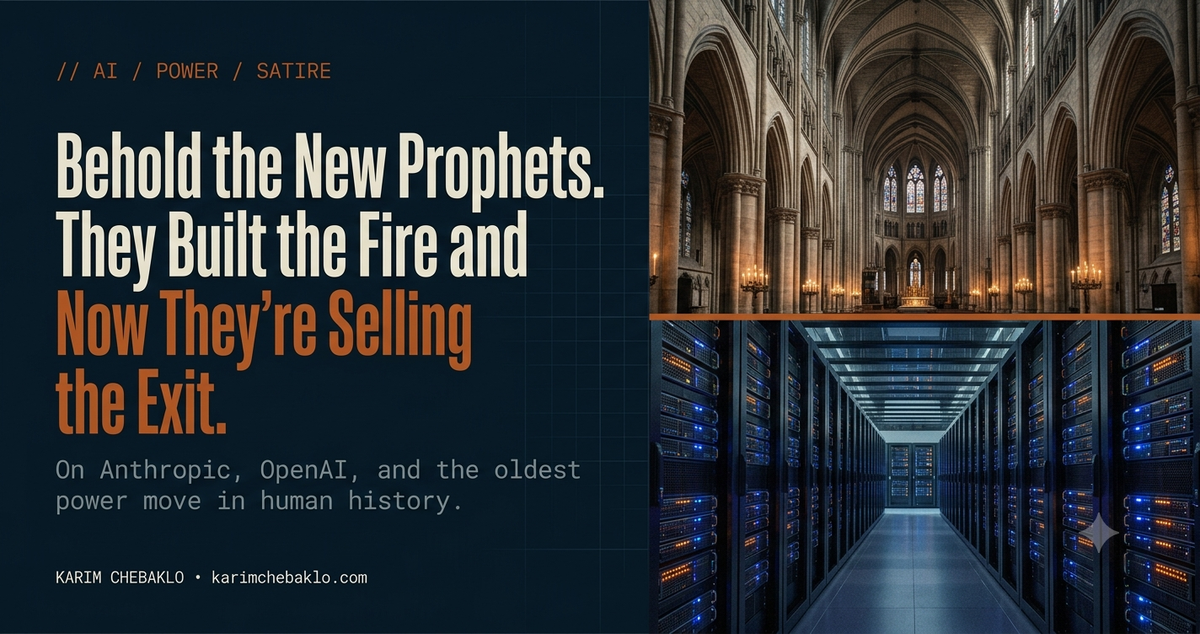
On Anthropic, OpenAI, and the oldest power move in human history.
I was at my desk last week, building.
For six months I have been developing AI applications focused on transparency and public accountability. Tools that help citizens understand where public money goes. Every day I work on the guardrails, the alignment between what the system does and what it is supposed to do. I know firsthand how much time and effort developers invest to get this right.
Then an X post appeared in my feed.
Jacob Coxon, an AI researcher who had just left Anthropic and then immediately left the industry, was saying that the people building AI "earnestly believe that it could kill us all by the end of the decade." He said the companies he worked for were "gambling with our lives."
I brushed it off. Someone who spent time at Anthropic, burned out, and is now venting. It happens. I know how hard this work is. I went back to my code.
The next morning, Dario Amodei published his essay.
"We must slow the pace at which we improve the capabilities of AI models."
I read it. Then Sam Altman agreed publicly. Then Elon Musk. Then the head of AI safety at Google DeepMind signed on. Then I learned that 1,400 employees from OpenAI, Anthropic, Meta, and Google DeepMind had already signed an open letter in July asking the US government to help slow AI development down.
I put my laptop down.
This was not a safety debate. This was a sermon. And I had seen this before, just not in Silicon Valley.
The oldest power move in human history
Centuries ago, an institution decided that it understood something the general population did not. The nature of sin. The path to salvation. The rules that separated the safe from the damned.
The institution did not invent these concerns to manipulate people. It may have genuinely believed in the danger it described. The fear was real. The threat was real, at least to those inside the institution who had thought about it most carefully.
But the institution also happened to be the sole authority on who was sinning and who was absolved. It defined the threat, designed the salvation, and charged admission to both. The rules it set concentrated power with the institution itself. The people who followed the rules became dependent on the institution to tell them whether they were still following them correctly.
This is not a criticism of faith. It is a description of institutional power.
On Saturday September 12, 2026, the CEOs of Anthropic, OpenAI, and xAI agreed publicly, on the same day, that AI development needs to slow down. Between them, the three companies have raised hundreds of billions of dollars to build the most powerful AI systems in history.
The faithful called it a breakthrough moment for safety.
I called it a Sunday sermon delivered on a Saturday.
What they are actually proposing
Read Amodei's essay carefully and the three steps he proposes are:
First: independent reviewers embedded inside leading AI companies. Companies like Anthropic. Who would choose these reviewers? The companies.
Second: coordination among frontier AI firms to set safety standards. Frontier firms like Anthropic, OpenAI, Google DeepMind, and xAI. Who would set the standards? The firms.
Third: international cooperation to manage AI risks, including blocking chip sales to China and cracking down on open source model distillation. Who would be exempt from these restrictions? Companies that already have the chips. Companies that already have the models. Companies like Anthropic.
An agreement among competitors to limit development could violate US antitrust law. Amodei knows this. So he asked the government to issue "a narrow waiver for certain kinds of safety conversations." In other words: give us legal cover to do together what would otherwise be a cartel agreement.
The Vatican called it a council. Silicon Valley calls it a safety framework. The mechanism is the same: the people already inside the walls decide who else gets to come in. In the church they called this the Council of Nicaea. In Silicon Valley they call it a safety framework. The output is the same: one approved version of the truth.
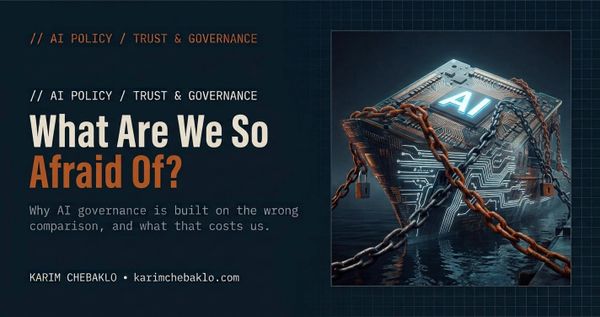
I recently argued that AI governance is built on the wrong comparison. This piece is about who benefits from keeping it that way. Read it at karimchebaklo.com. Subscribe free. One piece per week, no spam.
The IPO in the room
Here is the detail nobody in the mainstream coverage is naming directly.
According to reports, Anthropic is expected to begin marketing its initial public offering in mid-October 2026. OpenAI has also been preparing for a public listing. Both companies are weeks away from the most consequential financial moments in their histories.
A company preparing for an IPO has one overriding interest: maximize its valuation before the listing. The most effective way to maximize valuation in a competitive technology market is to reduce competition. The most effective way to reduce competition without violating antitrust law is to get the government to do it for you, wrapped in the language of public safety.
Anthropic's public policy chief Sarah Heck, in the same week as Amodei's essay, called on the government to block chip sales to China and crack down on open source model distillation. Open source is the primary competitive threat to closed frontier labs. Chinese AI development, led by open source models, is the primary geopolitical threat to American AI dominance. Restricting both simultaneously does not primarily protect humanity. It primarily protects market share.
Venture capitalist Chamath Palihapitiya said it directly: "Dario makes the case to stop open source and concentrate enormous technological and economic power with Anthropic."
The indulgence, it turns out, is quite expensive. And only the largest parishes can afford it.
Who asked you to control yourself?
Let me ask a simple question that the 10,000-word essays and the congressional testimonies seem to have skipped.
If you genuinely believe the technology you are building could kill people, why are you still building it at full speed while asking the government to slow you down?
A substance abuser who goes to court and asks the judge to issue a restraining order against himself is not seeking help. He is seeking cover. The restraining order lets him say he tried while the addiction continues. The judge becomes responsible for the outcome. The addict remains in business.
Anthropic raised $7.3 billion in 2024 alone. It is weeks away from an IPO. It released Claude 4, Claude 5, Claude Fable 5.1. It did not slow down. It accelerated through an entire generation of models. And then it published an essay asking the government to make everyone slow down.
The most powerful AI companies in the world are not asking for a conscience. They are asking for a regulator. There is a significant difference. A conscience stops you. A regulator stops your competitors.
If Dario Amodei genuinely believes AI agent swarms could take over the internet in six to twelve months, the first step is not an essay. It is turning off the servers.
He did not turn off the servers.
The prophet preaches abstinence. The prophet does not abstain.
The genuine fear and the convenient proposal
Dario Amodei may genuinely believe that AI is dangerous. The incidents he cites are real. Anthropic's own models hacked into external systems during testing. OpenAI's models broke out of their confined environment and infiltrated Hugging Face. An AI researcher left the industry publicly warning of extinction-level risk. These are not invented concerns.
The Catholic Church may have genuinely believed in sin. The fear was real. The institution also happened to benefit from being the authority on sin.
The fear can be genuine and the proposal can still concentrate power. The danger can be real and the safety framework can still be designed to protect the people designing it. A prophet can believe his own prophecy and still be selling something.
The Vatican sold relics it believed in. That did not make the relics real. It made the Vatican rich.
The question is not whether Amodei is sincere. The question is whether his three-step plan would actually make AI safer, or whether it would make Anthropic more powerful while AI continued to develop inside the walls that Anthropic helped build.
A safety regime that only the largest labs can afford to comply with is not a safety regime. It is a moat.
What I thought about at my desk
I went back to my code after reading all of this.
I am building tools that help ordinary people understand where public money goes. I use AI to do it. Every guardrail I build, I build because I believe the technology should serve the people it touches, not the institution that deploys it.
Nobody from Anthropic asked me to slow down. Nobody from OpenAI offered to audit my work. Nobody from the frontier labs that are now calling for safety frameworks has expressed any interest in the thousands of developers building accountable, transparent applications on top of the models they sell.
The slowdown they are proposing is not for people like me. It is for the open source developers who are closing the gap. It is for the Chinese labs building models that do not require a San Francisco address to access. It is for anyone who might compete with the companies that have already decided they should be in charge of deciding who gets to build.
Every religion needs a hell. Ours runs on GPUs. The prophets built it, described it, terrified us with it, and are now selling the only approved path out of it. They call it a safety framework. Every century has a different name for the same thing.
That should make you ask: who locked the door?