In Lebanon, Half a Tank Costs a Barrel. Let's Just Buy the Barrel.
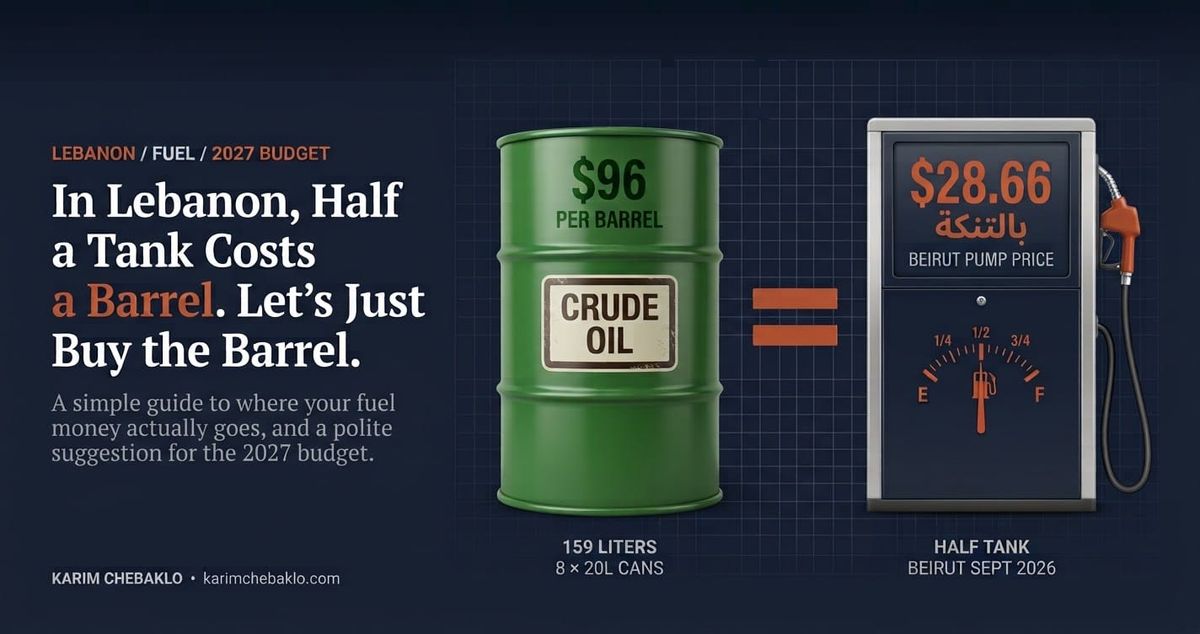
A simple guide to where your fuel money actually goes, and a polite suggestion for the 2027 budget.
Let me tell you something that will ruin your morning.
You already know it. You just haven't seen it written out this simply before.
A barrel of crude oil on world markets today costs $96. One barrel contains 159 liters, which is roughly eight 20-liter cans.
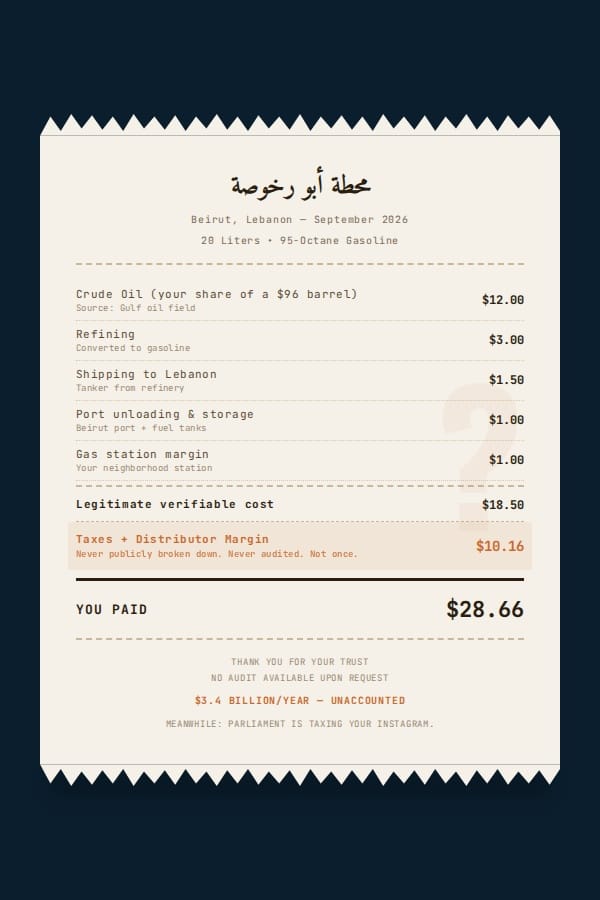
So one 20-liter can of crude oil at source costs $12.
You paid $28.66 for your 20 liters at the gas station yesterday.
Somewhere between the oil field and your tank, someone charged you $16.66 extra on something that started life worth $12.
Let's find out who.
The journey of your 20 liters
Crude oil needs to be refined before it becomes gasoline. That costs roughly $3 on your 20 liters.
It needs to be shipped to Lebanon on a tanker. Roughly $1.50.
It needs to be unloaded at the port and stored in a tank. Another $1.
The gas station needs to make something. Call it $1.
Total legitimate, verifiable cost to get 20 liters of gasoline from an oil field to your car: roughly $18.50.
You paid $28.66.
The difference: $10.16 per 20 liters.
That $10.16 goes to two places: government taxes and the fuel distributors' margin. Lebanon has never publicly explained how that $10.16 splits between them. The fuel distributors, the small group of companies that control all fuel imports into Lebanon, have never published an audited account. Not once in their history.
Nobody is accusing them of anything. Publishing your accounts is optional in Lebanon if you are well connected enough. The fuel distributors apparently are.
Now let's put that $10.16 into perspective.
Lebanon consumes 114,000 barrels of fuel per day. Each barrel fills roughly eight 20-liter cans. That means the unaccounted gap between what fuel costs to produce and what Lebanese pay for it amounts to approximately $3.4 billion per year flowing through a system with zero public audit. Even if half of that is legitimate government tax, the distributor margin that has never been publicly justified is worth $1.5 to $2 billion annually.
The entire 2027 Lebanese government budget needs $5.65 billion.
That is more than half the entire national budget flowing annually through a system that has never once been asked to show its work. Meanwhile, parliament is debating whether to tax your Instagram stories. The math, as they say, is not mathing.
The generator
The power is out. It is always out. You are on the generator.
The Ministry of Energy set the official generator rate for August at $0.538 per kilowatt hour.
A 5-ampere subscription running 16 hours a day uses roughly 248 kilowatt hours per month. At $0.538 each, that is $133. Add the fixed monthly fee of $4.29 and your generator bill is $137 per month.
In summer with air conditioning, or in a larger apartment, it is closer to $175.
Here is what makes the generator sector worth examining.
At the official diesel price of $26.93 per 20 liters, the generator owner's fuel cost to produce one kilowatt hour is approximately $0.539. That is almost exactly what the Ministry rate allows him to charge you. In other words, at the official rate, the generator owner barely covers his diesel cost before paying for maintenance, depreciation, or his own time.
So where does he make his money?
Two places. The fixed monthly subscription fee, which he charges regardless of how many hours the generator actually runs. And the fact that many generator operators charge above the official Ministry rate with essentially no enforcement consequences.
Your generator man operates a local monopoly. You cannot switch to a different generator. You cannot negotiate. You cannot ask to see his accounts. You pay what he charges or you sit in the dark.
Nobody has ever audited the generator sector. Same as fuel.
Your full monthly bill for things the state forgot to provide
Let's add it up.
Generator electricity: $137 to $175
For electricity the state is constitutionally obligated to provide.
EDL electricity bill: $20 to $40 per month
Fixed fees plus whatever consumption you actually received. A service that works a few hours a day at best. It bills you whether the power is on or not.
Fuel for your car (two fill-ups of 20 liters): $57
For roads the state hasn't properly maintained since approximately 1994.
Water delivery: $20 to $30
Because the public water network is not reliably drinkable.
Total monthly bill for services the state forgot to provide: $234 to $302.
The minimum wage in Lebanon is $312 per month. The national average hovers around $280 to $300. A middle-class professional in Beirut earns $500 to $1,200 depending on their sector. Even at the higher end, two fill-ups a month hurts. At the minimum wage, it is a survival calculation.
Your private survival infrastructure costs roughly what you earn. The math only works because of remittances from abroad, dollar savings from before 2019, or family support. On a purely local salary, it does not work. It has not worked for years.
And last week, the government submitted the 2027 draft budget to parliament. After careful review of Lebanon's fiscal situation, their big idea for closing the revenue gap is: a tax on social media. Not on the unaudited fuel margin. Not on the generator monopoly. On your Instagram.
Truly, a country that knows where the money is.
I write about Lebanon's political economy weekly at karimchebaklo.com. Subscribe free. One piece per week, no spam.
A modest proposal
The 2027 budget needs $5.65 billion.
Here is where some of that money actually is, without touching a single Lebanese consumer.
Tax the unaccounted fuel margin.
Require the fuel distributors to publish audited accounts. Show the Lebanese public exactly where that $10.16 per 20 liters goes. If the margin is fair, the audit will confirm it. If it is not, the state has a new tax base worth $1.5 to $2 billion annually. No new taxes on consumers. Just accountability from a cartel that has operated without any for decades.
Regulate the generator sector properly.
Cap margins. Enforce the pricing rules that already exist on paper but are routinely ignored. Tax profits above a fair benchmark. The generator monopoly exists because the state failed to provide electricity. That failure should not come with unlimited pricing power and zero accountability.
Charge fair rent for the coast.
Private interests occupy six million square meters of Lebanese coastline. Combined, they pay the state less than $500,000 a year. At fair market rates that land generates $30 to $50 million annually. You can guess why this isn't happening. Hint: the answer involves real estate and political connections, as all Lebanese math eventually does.
None of this is a new tax on the Lebanese consumer. It is collecting from the entities that have been profiting from the consumer's abandonment by the state.
The comparison that says everything
My son is in Montreal. He just started university. I was chatting with an Uber driver there yesterday.
20 liters of fuel in Canada: $26.40.
20 liters of fuel in Lebanon: $28.66.
Lebanon's fuel costs more than Canada's.
The average Canadian salary is $3,850 per month. The Lebanese minimum wage is $312 per month.
So the Lebanese pays more for his fuel than the Canadian. And earns twelve times less.
That is not a fuel price problem. That is a country problem.
The Lebanese consumer is already paying for his state. He pays for his electricity, his water, his fuel, his roads through the damage to his car's suspension.
He is just paying the wrong people.
The 2027 budget should fix that. Not by taxing his Instagram. By collecting from the ones who have been quietly collecting from him for decades.