I Was at a Concert While Forty Men Were Trapped in a Tunnel Eighty Kilometers Away. I Am Not Sorry.
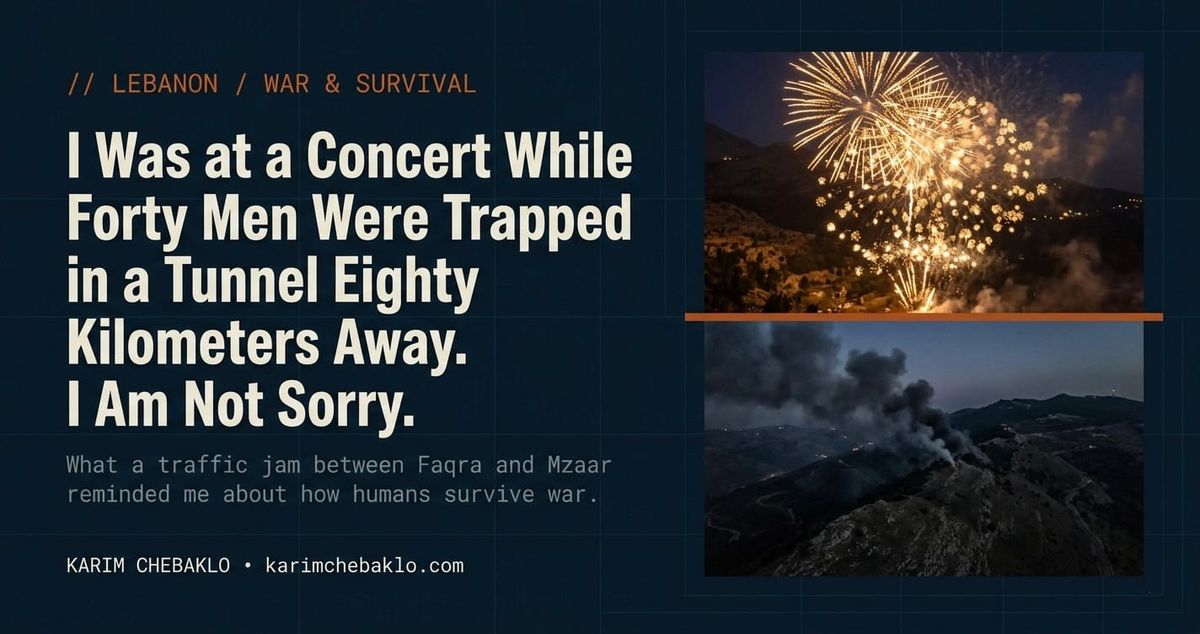
What a traffic jam between Faqra and Mzaar reminded me about how humans survive war.
I have been sitting in this car for forty minutes.
The road between Faqra and Mzaar is ten minutes on a normal day. Tonight is the Feast of the Assumption of the Virgin Mary. The ritual in Lebanon begins on the night of August 14th, not the 15th, and the mountain has been alive since sunset with music, crowds, and the particular energy that this feast brings every year to the Lebanese highlands. Thousands of cars are crawling toward the mountain resorts, toward the concerts, toward the fireworks that light up the Kesrwan sky every year, the way they have for as long as anyone can remember.
My phone buzzes.
Israeli forces are tightening their siege on the Ali Al Taher ridge near Nabatieh. Six hundred meters above sea level, overlooking the Litani valley, the ridge sits above what Israeli commanders call Hezbollah's underground nerve center, a tunnel complex Hezbollah spent twenty years building. Around forty Hezbollah fighters are reportedly surrounded inside. The fighting has been going on for weeks.
The ridge is approximately eighty kilometers from where I am sitting in this traffic jam.
Eighty kilometers. In Lebanon, that is a different world.
Then I hear it. A boom. I see the flash in the sky above the mountain.
It is not Ali Al Taher. It is not Israeli bombs. It is the fireworks beginning early, somewhere up the mountain, someone jumping the gun on the feast.
Two sounds. The same sky. Eighty kilometers apart.
Two Lebanons in the same country
The mountain Lebanon I am sitting in tonight is fully operational. The restaurants are booked. The pool clubs are packed. The summer season has resumed with the particular Lebanese intensity that outsiders always find bewildering and locals find completely natural.
And this is not any mountain. The cars around me carry Lebanese of every sect. Christian, Muslim, Sunni, Shia, Druze. The Feast of the Assumption belongs formally to the Christian calendar but the mountain in August belongs to everyone. The families heading to the concert are not defined by religion. They are defined by geography: they are the Lebanese who are here, on the mountain, rather than there, in the south.
The division is not between Christians and Muslims. It is between Hezbollah's war and everyone else's summer.
The south Lebanon that my phone is reporting on is a different country. Villages emptied. Fighters on both sides dying for a ridge whose tunnels most of the people heading to tonight's concert could not describe. Forty men trapped underground while forty thousand people head to a feast eighty kilometers away.
I am in the traffic jam heading to the feast. I am also, in some part of my mind, watching the ridge.
I am not unusual. This is Lebanon.
This is not a Lebanese disease
Before anyone reads this as an indictment of Lebanese priorities, let me say clearly: we did not invent this.
When Russian forces were destroying Mariupol in March 2022, Kyiv's restaurants were full. The city was under missile threat, the country was at war, and people were drinking wine and listening to music in the capital because what else do you do? You cannot grieve at full intensity indefinitely. The human nervous system does not allow it. So you go to dinner, and you check your phone, and you go back to dinner.
During the Spanish Civil War, Madrid held its cultural season while the front lines moved closer. Concerts, theatre, art exhibitions. Franco's forces were advancing. The city dressed up and went out. Not because the people of Madrid did not understand the war, but because understanding the war and continuing to live were not mutually exclusive. They were the only way to survive it.
The compartmentalization is not a character flaw. It is a species-wide adaptation.
What Lebanon adds to this universal pattern is geography and history compressed into a very small space. Eighty kilometers in most countries is nothing. In Lebanon, it is the distance between two entirely different realities because Lebanon has always been a country of parallel realities existing simultaneously, rarely touching, occasionally colliding catastrophically.
Why the mountain works this way
The mountain in August is not escapism in the pejorative sense. It is something older and more complicated.
Lebanese mountain culture in summer is partly celebration, partly defiance, partly genuine joy, and partly a collective agreement to maintain the social fabric that war keeps trying to tear. The Feast of the Assumption is not a party that happens to coincide with a war. It is a feast that has survived every war Lebanon has ever had, which is most of Lebanon's modern history. The fireworks over Mzaar are the same fireworks that went up in 1983, in 1989, in 1996, in 2006, in every year that Lebanon was simultaneously at peace in one place and at war in another.
The people in the cars around me are not ignorant of what is happening in the south. Their phones are buzzing too. They know about Ali Al Taher. They know about the forty men trapped in the tunnel. They have family in the south, or friends, or at minimum the abstract awareness that eighty kilometers away people are dying for a ridge.
They are going to the feast anyway. Not because they don't care. Because this is how you survive a country that has been at war, in one form or another, for most of the last fifty years. You build a life in the space between the wars, and when the wars encroach, you protect that space with everything you have, including fireworks on August 14th.
I write about Lebanon weekly at karimchebaklo.com. If this resonates, subscribe free — one piece per week, no spam.
What this detachment actually costs
There is something the compartmentalization does that is worth naming honestly.
It makes the political cost of the war invisible to the people who are not paying it.
The families displaced from the south are not in the traffic jam. The fighters on the Ali Al Taher ridge are not at the concert. The people who bear the physical cost of Lebanon's wars are, by geography, systematically the same people, generation after generation. The south bleeds. The mountain are festive. And because both things happen in the same small country, the people on the mountain can tell themselves they understand the war while the people in the south live it.
This is not unique to Lebanon. The Ukrainian elite who stayed in Kyiv experienced a different war than the families of Mariupol. The Spanish intellectuals who attended theatre in Madrid during the Civil War were not the ones dying at the front. Distance from the front line has always correlated with distance from the full weight of the war's reality.
But in Lebanon, the distance is particularly sharp because it follows a specific political map. The south's war is Hezbollah's war. Most Lebanese, across all sects, did not choose it, do not want it, and cannot stop it. The mountain tonight is not indifferent to the south. It is full of people who have no say over a war being fought in their name by an armed faction that answers to no Lebanese government and no Lebanese ballot.
That is the real cost of the compartmentalization: not that people go to concerts, but that the political will to end the conditions that produce the wars is diluted by the ability of half the country to not feel them directly. And the other half has no choice but to feel them entirely.
The hill and the fireworks
The traffic moved again. Slowly, but moving.
The fireworks went up properly later that night. They were beautiful. They lit up the valley below Mzaar the way August 14th always does, and the crowd cheered, and for a moment the whole mountain felt like the Lebanon that exists in the imagination, the one we keep rebuilding every summer in the space between the wars.
Somewhere, my phone buzzed again. The siege of Ali Al Taher continues. Forty men in a tunnel. The ridge holds.
Both things are true at the same time. They have always been true at the same time. This is not a failure of Lebanese character. It is the condition of living in a country whose wars are chosen by those with weapons and paid for by those without them.
The fireworks are not the problem. The ridge is the problem. And the ridge will still be there, whichever side eventually holds it, long after the feast is over, the mountain empties out, and Lebanon goes back to being whatever Lebanon is when it stops pretending everything is fine.