Equal Votes, Unequal Wars
Plato warned that democracy counts an informed vote and an uninformed one the same. Now it's deciding wars that way too.
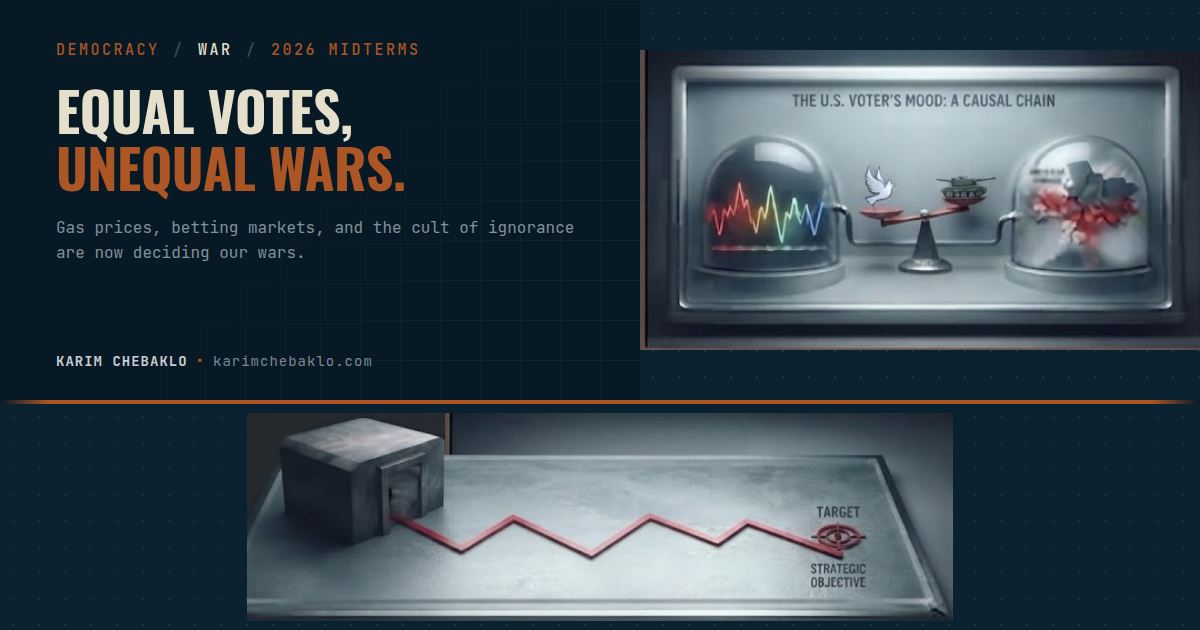
Gas prices, betting markets, and the cult of ignorance are now deciding our wars.
Plato once warned that democracy dispenses "a sort of equality to equals and unequals alike." He did not mean it as a compliment. In the Republic he traces democracy's slide toward tyranny precisely because it refuses to distinguish the citizen who has studied a question from the one who has not. Both get a vote. Both votes count the same. A state that cannot tell the difference eventually hands itself to whoever shouts loudest. Isaac Asimov, two and a half millennia later, gave the warning its modern shape: a cult of ignorance, nurtured by the notion that "my ignorance is just as good as your knowledge." Critics in their own time called both men elitists. Both were simply describing arithmetic. One citizen, one vote, regardless of what either citizen actually knows, is not a bug anyone has bothered to hide. It is the entire design.
Which is why it is strange that we still pretend wars are decided by generals.
Consider Israel. On October 27, the country holds a national election. The timing was not chosen; the Knesset's four-year term simply expires, the first time since 1988 it has been allowed to run its full course without early collapse. The date was fixed years before anyone knew what September 2026 would look like on a map of southern Lebanon. It does not matter. The clock does not consult the battlefield. Whatever the state of the ceasefire, whatever capability Hezbollah has left, whatever the general staff, on both sides, believes the next six months require, none of it matters. The constitutional alarm goes off on schedule, and the country puts its entire strategic posture, again, in the hands of everyone. Military planners spend careers learning terrain, logistics, an enemy's order of battle. None of it outranks a date on a calendar set before the war began.
The United States has found an even more elegant mechanism, and deserves real credit for it. Since February, when American and Israeli strikes assassinated Iran's Supreme Leader and much of the senior command in a single operation, Washington has run the largest regional military buildup since the invasion of Iraq. Aircraft carriers, ceasefires, ceasefire violations, a closed Strait of Hormuz, a toll regime run by a wounded but unbroken Iranian state. All of it serious. All of it, per the president's own public statements, scheduled to resolve itself "immediately after" the November midterms. Not because Tehran's succession crisis will be settled by then. Because gasoline will cost whatever gasoline costs. The national average is $4.27 a gallon, up thirty percent on the year, and a voter who could not locate the Strait of Hormuz on a map is, this fall, the entire war cabinet. Approval ratings have fallen with the same rhythm as gas prices have risen, which is either a remarkable coincidence or the only poll that has ever mattered.
Spare a moment for the other side of this equation. Tehran does not hold elections that mean anything, does not face a midterm, does not need to time a strike around anyone's mood at the pump. And yet its own general staff, severely damaged as it is since February, must still war-game an enemy whose actual chain of command runs, some months, through a ballot count. Does the counterattack wait until Wednesday, in case Tuesday's results change who controls Congress and the war-funding bill? Does a resupply run to the Houthis get held over a weekend because a swing state might swing? A regime built entirely around giving an order and having it obeyed indefinitely now has to ask whether Washington's order still holds if Michigan breaks the wrong way. It is a strange kind of war in which the side with the most rigid, most unaccountable chain of command spends its planning cycle trying to forecast someone else's mood. Because the mood, this time, is the strategy.
For those who find even a ballot too indirect an instrument, there is now a purer option. Polymarket alone has taken in over a hundred million dollars in wagers on whether American forces would formally enter Iran. It priced the odds above ninety percent. Traders have put real money on whether Khamenei's son inherits the leadership, whether the Strait stays closed, and whether a nuclear deal lands before the year is out. The odds on that longer-dated question slid from thirty-five percent to nineteen within months, tracking headlines rather than anything happening in a centrifuge hall.
This is democracy with the civic performance stripped out. No need to pretend you have read a briefing. No need to feel bad about not reading one. Just show up with a wallet and a hunch, and your ignorance is denominated in the same currency as somebody else's classified assessment. Regulators have since asked, gently, whether some of that money moved a little too early, a little too precisely, to have come from a hunch at all. The market noticed what the ballot never bothers to ask.
None of this is a flaw to be patched. It is a system working exactly as specified, and the honest response is not outrage but gratitude that we have finally found instruments simple enough for everyone to use. Why stop at gas prices and order books? Let a foreign ministry's approval rating move with its Google reviews. Let a ceasefire's survival depend on whether it trends favorably before the weekend news cycle resets. A war against a nuclear-threshold state mid-succession can turn on the price of a gallon of gas or a Tuesday afternoon swing on a betting app. There is no principled reason a bad retail quarter shouldn't end a peace deal by Friday. Increasingly, the only requirement is being solvent enough to place a bet. We have simply been too polite, until now, to say so out loud.
Here is the part satire usually skips, because it is less fun than the joke. The fix is not fewer voters, or wiser ones, or a licensing exam at the ballot box. The historical version of that idea has always ended with someone deciding whose ignorance counts and whose does not, and it is never applied evenly.
Democracies already know how to wall off decisions that require specialized judgment from the raw popular vote. Interest rates are not set by referendum. A drug is not approved by a poll of how people feel about their health that week. War is the one instrument we have never dared insulate the same way, and there are real reasons for that. A general who cannot be voted out is a much older and much worse problem than a voter who checks the odds before the map. So we are left with the arithmetic Plato pointed at from the start: no clean fix, just the choice of which unaccountable failure mode you find less frightening.
Ask yourself which side of that arithmetic you were on the last time you formed an opinion on a war you could not find on a map, or checked the odds before you checked the briefing. Democracy never promised you would be right. It only promised to count you exactly the same as everyone else, whether they checked or not.