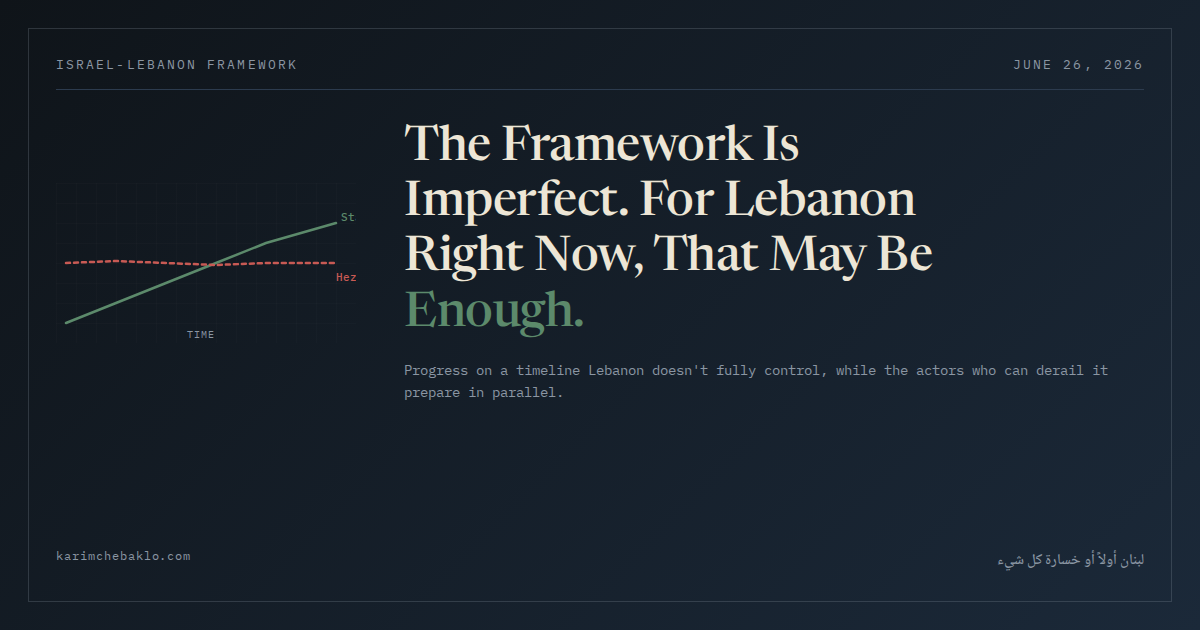
The Framework Is Imperfect. For Lebanon Right Now, That May Be Enough.
When Hezbollah's ministers did not resign from the Council of Ministers yesterday, that silence was more significant than the tire-fires burning in Beirut's streets.
A government party rejecting a framework is theater. A government party rejecting a framework while staying at the cabinet table is a signal: we're going to fight this from inside the system, not from outside it. That shift, small as it seems, represents something Lebanon hasn't had in years. A state willing to move forward incrementally. A rival actor willing to negotiate its terms from within government rather than blow up the system over it.
The framework agreement signed on June 26 is not the solution to Lebanon's disarmament challenge. It is not a guarantee of sovereignty. It does not commit to Lebanese military rearmament or Iranian withdrawal. By the standard of what would actually resolve the underlying problem, it is deeply insufficient.
But by the standard of what a Lebanese government with limited leverage can actually extract from a regional negotiation it did not design, it represents progress. And that distinction matters.
What actually changed from a week ago
A week ago, there was no framework. There was a US-Iran MOU that named Lebanon but gave Lebanon no seat at the table. There was ongoing Israeli occupation of nearly one-fifth of Lebanese territory. There was no process, no mechanism, and no agreed structure for how disarmament would happen or who would enforce it.
Today, there is a framework. It is specific on certain points: Israel will withdraw from two areas in southern Lebanon, transferring the sites to the Lebanese military. These are not symbolic. They are defined geographic areas where Lebanese forces will take control.
A trilateral Military Coordination Group has been established for Lebanon, creating a formal mechanism for the three parties (Israel, Lebanon, US) to coordinate implementation. That mechanism didn't exist before.
The US has committed $100 million in humanitarian assistance and to train Lebanese troops. That is not a comprehensive rearmament package, but it is not nothing. It is a commitment tied to Lebanese military capacity.
And most critically: Lebanon's Ambassador to the US, Nada Hamadeh Moawad, stated the agreement would be the "first step on the road to restoring Lebanese sovereignty and territorial integrity." Lebanon got a statement on the record that this is a process, not a final arrangement. That matters for future negotiation.
What this framework reveals about Lebanese political will
The government signed this knowing its gaps. President Aoun and Prime Minister Nawaf Salam understood, before they put pen to paper, that the framework does not commit to Lebanese military rearmament or Iranian withdrawal. They signed it anyway.
That is not naïveté. That is calculation. It is a government saying: "We cannot get everything we need right now. But we can get a defined process, a mechanism, and concrete steps. Let's take those and use them to push for the next increment."
Hezbollah's reaction proves they understood this too. A senior Hezbollah-affiliated lawmaker said Lebanese authorities would need to fight a "civil war" if they wanted to enforce it. That is inflammatory rhetoric. But the ministers stayed in government.
If Hezbollah believed the framework would actually disarm them, they would have exited government immediately. If they thought the Lebanese state had the capacity and will to enforce it, they would have signaled a harder break. Instead, they stayed at the cabinet table and positioned themselves to manage the framework's implementation from inside government.
That is also calculation. It is Hezbollah saying: "We reject this, but we're not abandoning our seat in the system. We'll fight this from inside."
For the first time in years, all major parties are choosing to stay within the political system rather than blow it up over a single dispute. That is not sovereignty restored. But it is political coherence. The minimum requirement for incremental progress.
What realistically comes next
The framework is a stepping stone, not a destination. The next steps are:
Phase One: Pilot Zone Enforcement (6-12 months)
Israeli forces will pull out of two areas, located inside the six-mile-long buffer zone the IDF has established in southern Lebanon. Lebanese forces will move in. The coordination group will monitor.
This is not disarmament. This is territorial control. But territorial control is how the Lebanese state builds leverage. If Lebanese forces can demonstrate competent control of these pilot zones, if they can maintain security, prevent Hezbollah from using the areas as a staging ground, and show they're a functional authority, that becomes evidence for the next phase.
Success here is not "Hezbollah disarmed." Success is "Lebanese state demonstrated capacity in defined territory." That's what the next negotiation will be built on.
Phase Two: Incremental Expansion (12-24 months)
If the pilot zones work, the argument for expanding them becomes stronger. Not because the framework says so, but because the evidence says so. A Lebanese government that can show it controls these areas can demand: "Expand the pilot zones. Give us more territory. Give us more responsibility."
That is how leverage is built incrementally. By performing competence in small areas and using that performance to demand more.
Phase Three: Leveraging for Capacity (24+ months)
Every successful pilot zone creates political space for the Lebanese government to return to the US and say: "We need better equipment. We need more training. We need capacity to hold these areas against pressure." That conversation becomes easier if the zones are actually secure.
Again, this is not disarmament. But it is the pathway to it. A government building strength through demonstrated competence, then using that strength to make demands.
What Hezbollah's silence signals
Hezbollah's ministers staying in government tells you something important: they believe they can manage this process. They may be right or wrong, but their calculation is that they have more leverage inside government than outside it.
That means the next phase is going to be fought inside the Council of Ministers, not on the streets. Hezbollah will push back against Lebanese force deployments in the pilot zones. They will argue that Israeli occupation elsewhere makes the framework illegitimate. They will use every parliamentary mechanism to slow implementation.
A Lebanese government that understands this can prepare for it. They can document Hezbollah obstruction. They can build a public record of "we tried to implement, Hezbollah blocked it." That record becomes ammunition for the next round of international pressure.
This is not glamorous. It is not the kind of strategic victory that gets written about as a turning point. But it is how states that lack overwhelming power actually move the needle.
The fragility of the timeline: What the framework assumes vs. what's actually happening
The incremental strategy assumes something that may not be true: that time works for the Lebanese state.
The framework creates a window. The Lebanese government is using it to build capacity through pilot zones, to demonstrate competence, to leverage that competence into more territory and more resources. That is a rational strategy for a constrained actor.
But Hezbollah and Iran are using the same window for a different purpose. They are not waiting for Lebanese state capacity to build. They are rearming.
The three-part vulnerability:
First: Hezbollah is consolidating and modernizing its arsenal during this period.
The framework does not disarm Hezbollah. It does not restrict Iranian supply lines. It does not monitor Hezbollah's weapons movement or acquisition. During the pilot zone phase, while the Lebanese state is focused on proving it can control small areas, Hezbollah has room to reposition its arsenal, receive new supplies from Iran, and reorganize its command structure.
The government is assuming Hezbollah will remain static while state capacity builds. Hezbollah is assuming the opposite. That this period of diplomatic engagement creates space to strengthen its position for the next round.
Second: Israel maintains unilateral right to define and eliminate "threats" within its security zone.
Israel's official position is that it maintains "freedom of military action throughout the security zone to eliminate threats of any kind." Note the word: "any kind." This is not contingent on Hezbollah violating the framework. It is Israel's unilateral right to strike based on its own assessment of what constitutes a threat.
A visible arms shipment to Hezbollah during the pilot zone phase is not a framework violation by Hezbollah. It is, however, grounds for Israeli preemption under Israel's stated doctrine. Israel does not need Hezbollah to break the framework to justify military action. It only needs to perceive a threat.
And if Hezbollah is rearming during this period, that perception becomes increasingly difficult to avoid.
Third: Iran controls when Hezbollah escalates, and the framework constrains nothing about Iranian behavior.
The US-Iran MOU is a separate agreement. The Israel-Lebanon framework is a separate agreement. Neither constrains Iran's ability to order Hezbollah to escalate. Iran is not a party to either framework. Iran is not bound by either framework's terms.
If Iran decides the geopolitical moment favors escalation, if sanctions relief stalls, if negotiations break down elsewhere, if the regional balance shifts, it can order Hezbollah to attack. The framework provides no enforcement mechanism against Iranian orders. It provides no deterrent against Iranian supply line expansion. It creates a diplomatic structure between Israel and Lebanon, but not between Israel and Iran, and not between Lebanon and Iran.
Where this collapses:
One visible Iranian arms shipment. One Israeli strike on perceived Hezbollah repositioning. One Iranian order to Hezbollah to test Israeli tolerance. Any of these triggers the same cycle the framework was supposed to interrupt:
- Hezbollah attack
- Israeli retaliation
- Framework breakdown
- Pilot zones abandoned
- Israeli security zone expanded again
- Back to occupation
The Lebanese government's incremental strategy is sound if all parties are constrained by the framework. But they're not. Hezbollah is rearming. Iran is not bound by the framework. Israel retains full freedom of action to preempt perceived threats.
The government is building a house while three other actors are preparing either to set fires or to demolish it.
The realistic verdict: Progress with embedded risk
The framework is not a solution to Lebanon's disarmament challenge. It does not guarantee sovereignty. It does not constrain Hezbollah rearmament, Iranian behavior, or Israeli prerogative.
But it does three things that matter:
First: It establishes a process where none existed. Lebanon now has a defined framework, not just ongoing occupation.
Second: It gives the Lebanese government a mechanism to build leverage incrementally. The pilot zones are that mechanism. If they work, they become evidence for demanding more.
Third: It forces Lebanon to operate within a diplomatic structure, which creates some constraint on escalation. Though that constraint is fragile, and the constraint applies only to Lebanon and Israel, not to Hezbollah or Iran.
A government that moves incrementally, that understands its constraints, and that builds leverage through demonstrable competence is doing what Lebanon's political reality permits.
But that same government is also playing on a timeline that is not entirely in its control. While it builds pilot zones and demonstrates state capacity, Hezbollah is rearming, Iran is controlling the escalation clock, and Israel retains the right to strike based on its own threat assessment.
The framework is progress. But it is progress inside a trap. The Lebanese state is moving forward, but the actors who can derail it are moving too. In different directions, toward different goals, on timelines that may collide with the state's incremental strategy.
The next twelve months will reveal whether the Lebanese government can hold these pilot zones, whether the coordination mechanism can function, and whether small victories can be leveraged into larger ones.
But it will also reveal whether Hezbollah's rearmament becomes visible, whether Iran decides escalation serves its interests, and whether Israel's freedom of action overrides the framework's diplomatic constraints.
The government is making the right incremental moves. Whether those moves survive the period they've been given depends on factors the framework does not control.
لبنان أولاً أو خسارة كل شيء