The Rabbit Always Works. Except When You Need 43 Votes
Nabih Berri is searching through the constitution. Constitutional clauses. The Taif Agreement. The ambassador's legal authority. He is not specifying what he means. He is leaving it vague, letting people wonder if he has a legal weapon or if he is just buying time.
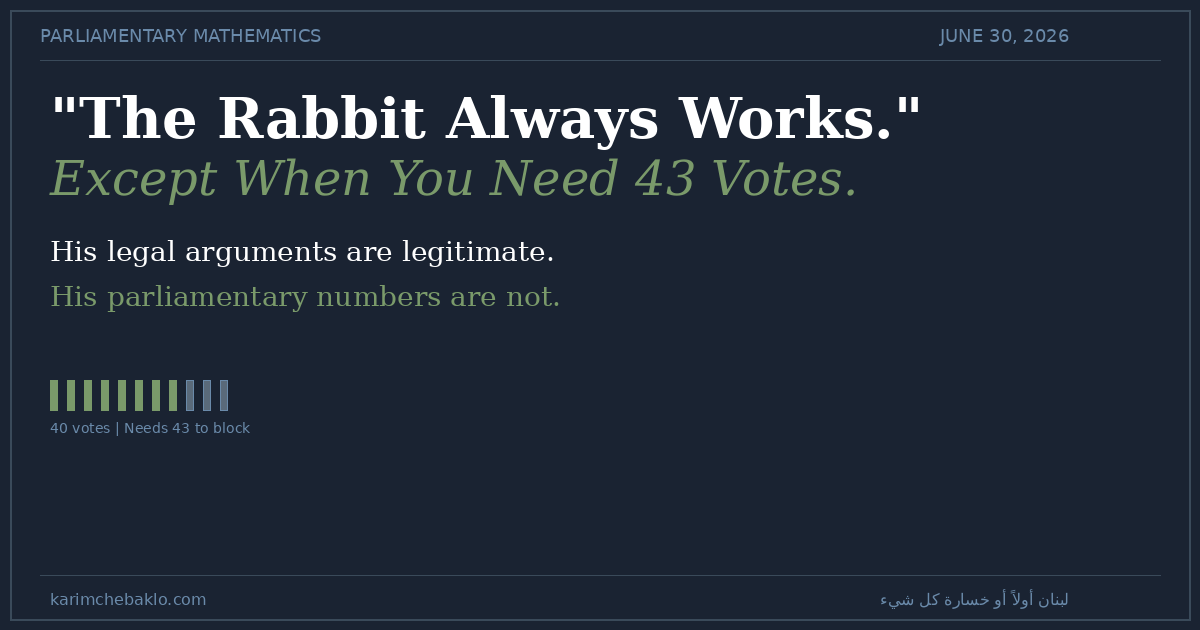
But here is the actual problem Speaker Berri faces: He does not have the parliamentary votes to block the framework. He is short 2 votes mathematically. So he is searching the constitution for a legal mechanism that compensates for his political weakness.
It is time to map out every legal route Speaker Berri could theoretically use, evaluate which ones have actual teeth, and distinguish between his legitimate constitutional arguments and his impossible parliamentary math.
The answer matters because if Speaker Berri cannot block the framework through votes, then his constitutional search is not a legal challenge. It is a delay tactic. And Lebanon needs to know the difference.
What Speaker Berri is claiming (the vague version)
Speaker Berri has said:
- The framework touches the "essence of the Taif Agreement"
- The ambassador who signed does not have legal authority to sign such a deal
- Constitutional clauses exist that could block implementation
- He is searching through the constitution for a route
He has not specified which clauses, which Taif provision, or what the ambassador's legal deficiency is. That vagueness is intentional. It creates uncertainty.
All possible legal routes Speaker Berri could claim
Lebanon's constitutional framework gives Speaker Berri (as Parliament Speaker) leverage points in five areas. Not all are equally strong.
Route 1: Article 52 ratification requirement
The constitutional claim:
Article 52 states that certain treaties require Chamber of Deputies approval. Specifically: "Treaties involving provisions related to the State finances, trade treaties, and other treaties which cannot be annulled on a yearly basis, cannot be ratified except after the approval of the Chamber of Deputies."
Does the framework qualify?
This is debatable but likely YES. The framework involves:
- $100 million US commitment for Lebanese military training
- Defined security arrangements (which have financial implications)
- A process that cannot be reversed yearly
Speaker Berri's leverage:
If Parliament must approve, Speaker Berri (as Speaker) controls the agenda. He can delay bringing it to a vote. He can obstruct procedural votes. He can block ratification entirely if he maintains a coalition.
Legal strength: STRONG on this one
The constitution is clear. If the framework involves state finances, Parliament approval is required. Speaker Berri likely has legitimate legal ground here.
But here is the catch:
The framework was already signed by the President. Article 52 says treaties "cannot be ratified except after approval." The question is: Does signing = ratification? Or is ratification a separate step?
If signing is ratification, Speaker Berri is too late. If ratification requires a separate formal act by the government, Speaker Berri can block that act.
This is where constitutional interpretation becomes political. And Speaker Berri's argument has weight.
However, the government's counter-argument is stronger than it appears:
The government can argue that signing the framework at the State Department constitutes ratification. Article 52 applies prospectively to future treaties, not retroactively to treaties already signed. By this logic, Speaker Berri's Article 52 argument applies to a treaty that has already been ratified. The constitutional requirement has been satisfied (by the President and Cabinet acting together). Parliament's approval cannot retroactively void what has already been done.
This is not a certainty. Constitutional scholars will debate it. But it weakens Speaker Berri's legal position. He is arguing for a constitutional mechanism that may have already been bypassed by the executive's actions.
Route 2: The Taif Agreement "essence" violation
What Berri is claiming:
The framework violates the "essence" of the Taif Agreement. He has not specified which provision.
Possible Taif provisions he might cite:
- Taif established a balanced confessional system and national unity government. A framework signed without Hezbollah's consent could be framed as violating the principle of national consensus.
- Taif affirmed Palestinian rights and resistance. A framework with Israel could be framed as incompatible with Taif's pro-Palestinian stance.
- Taif required foreign troops to withdraw (it was about Syrian withdrawal in 1989). A framework that allows Israeli troops in a "security zone" could be framed as violating Taif's withdrawal principle.
The legal problem:
The Taif Agreement is a political document, not a legally enforceable treaty. It cannot be enforced in court. It cannot block a treaty ratified by the government and Parliament. It can only be invoked as a political argument.
If Berri claims the framework violates Taif, he is making a political case to Parliament, not a legal case. He is asking MPs to block it on principle, not because law compels them to.
Legal strength: WEAK
This is theater. Taif violations are political arguments, not legal blocks. Berri can make this argument to sway MPs, but he cannot use it as a constitutional barrier.
Route 3: The ambassador's legal authority challenge
What Berri is claiming:
The ambassador who signed the framework (Lebanese Ambassador Nada Hamadeh Moawad) is "an employee" and lacks the legal persona to sign such a deal. Only the President can sign, he might argue.
The legal reality:
Ambassadors are formally appointed representatives of the state. They have delegated authority from the President to negotiate and sign agreements on behalf of the state. This is standard international practice and is recognized in Lebanese law.
Ambassador Moawad was formally appointed by Aoun to lead the negotiating delegation. She had explicit authority to sign on behalf of Lebanon.
For Berri's argument to have weight, he would need to show:
- That her appointment was defective, OR
- That she exceeded the scope of her authority, OR
- That such agreements cannot be signed by ambassadors under Lebanese law
None of these are true. Her authority was clear. The appointment was proper. Ambassadors routinely sign agreements of this scope.
Legal strength: VERY WEAK
This claim has almost no legal standing. Berri would be arguing against basic principles of international and Lebanese law.
Unless he can show her appointment was revoked or that Aoun did not authorize her signature, this argument collapses immediately.
Route 4: Constitutional Council challenge
The mechanism:
Lebanon has a Constitutional Council. It can review laws for constitutionality. Berri could theoretically ask the Council to review the framework.
The problem:
The framework is not a law. It is an international agreement. The Constitutional Council has limited jurisdiction over international agreements (it typically reviews domestic legislation). Also, bringing a challenge to the Council requires specific standing and procedural steps. Berri would have to formally petition and meet jurisdictional requirements.
More importantly, the Council is slow. By the time it ruled, implementation would already be underway. So this route is theoretically available but practically useless as a blocking mechanism.
Legal strength: WEAK/PROCEDURAL
Technically possible but unlikely to succeed and too slow to matter.
Route 5: Government obstruction through procedural pressure
The mechanism:
If Berri can pressure Cabinet ministers to abstain or obstruct implementation procedures, he can slow the process. But in Lebanon's confessional system, the resignation of one sect's ministers does not collapse the government. The Cabinet functions with whoever remains.
Even if all Shia ministers resign, the government does not fall. It continues operating with Sunni, Christian, and Druze ministers. The framework can still be implemented, though possibly with reduced institutional efficiency.
This is political obstruction, not legal blocking. It slows things down but does not stop them.
Legal strength: NOT LEGAL
This is friction, not a veto.
The parliamentary math: Speaker Berri's real constraint
Before analyzing legal routes, the numbers matter most.
Speaker Berri's maximum blocking coalition:
- Amal (his party): 15 seats
- Hezbollah allies (Loyalty to Resistance): 15 seats
- Reformists/Independents aligned with him (Khalaf, Kaakour, Jarade, Frangieh): 4 seats
- Other independents he could potentially flip: 6 seats maximum
(Note: Fouad Makhzoumi, a key independent, votes with Aoun on sovereignty issues. This removes him from Speaker Berri's pool. Of the remaining 6 independents, only 2-3 are realistically persuadable; the rest are likely pro-Aoun or genuine swing votes unlikely to commit to blocking.)
Total maximum realistic: 40 votes
To block ratification, Speaker Berri needs: 43 votes (1/3 + 1 of 128)
Speaker Berri is short 3 votes. The math is actually worse than initially calculated.
However, this calculation assumes full attendance of all 128 MPs. Attendance is a variable Speaker Berri can control. With 110 MPs present, he needs only 37 votes to block (1/3 + 1 of 110). With 100 present, he needs only 34.
Controlling parliamentary attendance is leverage. If Speaker Berri can keep opposition MPs absent through procedural delays or political pressure, his blocking threshold drops and his 40-vote coalition becomes sufficient.
The Jumblat variable:
Walid Jumblat's Democratic Gathering holds 8 seats and announced opposition to the framework. However, Jumblat also announced he supports President Aoun and Prime Minister Salam and will not join Speaker Berri's blocking coalition. His position is: oppose the framework on principle, but do not obstruct the government's implementation.
This is devastating for Speaker Berri. It shows that even MPs who disagree with the framework will not join a blocking coalition. Opposition to the framework does not translate to votes for blocking. Speaker Berri cannot even convert his natural allies—those who share his reservations—into a coalition.
This is where procedural control matters more than raw votes.
Speaker Berri can delay. He can obstruct. He can use parliamentary procedure to slow implementation. But he cannot prevent ratification if President Aoun maintains his coalition. He lacks the votes.
This changes everything about his constitutional search. Speaker Berri is not looking for legal routes because he has blocking power. He is looking for legal routes because he LACKS blocking power and needs a constitutional mechanism to compensate.
What Speaker Berri can do (even without blocking votes)
While Speaker Berri cannot block the framework outright, his control of parliamentary procedure gives him significant leverage to obstruct implementation:
Delay through procedural obstruction: Speaker Berri controls the parliamentary agenda. He can delay bringing ratification votes to the floor indefinitely. He can require multiple readings of legislation. He can force committee reviews. Each delay gives Hezbollah time to rearm, negotiate, or create facts on the ground.
Demand amendments as leverage: Speaker Berri does not need 43 votes to block. He needs enough votes to make passage difficult enough that the government agrees to amendments. If he can maintain 35-40 votes, he can demand concessions: modifications to Article 13, changes to the Security Annex terms, or political commitments from Aoun.
Exploit procedural voting: Parliamentary procedure requires quorum (two-thirds of MPs present). Speaker Berri can call for quorum checks that disrupt the vote. He can demand roll-call votes instead of voice votes, slowing the process. These are not blocks. They are delays that create political damage.
Wear down the government politically: Each delay, each procedural obstruction, each demand for amendments creates the appearance that the government is struggling to pass the framework. This weakens Aoun's political position domestically and internationally. Speaker Berri's goal may not be to block, but to make the framework's passage so difficult and costly that Aoun must offer major concessions.
The distinction matters: Speaker Berri cannot prevent the framework from passing. But he can make passage painful, slow, and conditional on concessions he extracts. That is leverage without a blocking coalition.
The verdict
Speaker Berri is not bluffing on the law. His Article 52 argument is legitimate and has real legal weight. But he is bluffing on his ability to enforce it.
His constitutional research is genuine. If Parliament approval is required, Article 52 gives him procedural leverage. He can delay. He can demand amendments. He can obstruct votes.
But he cannot block ratification outright. He lacks the 43 votes needed to prevent passage.
So Speaker Berri's strategy is clear: Find a legal mechanism that compensates for his parliamentary weakness. If Article 52 applies, he can at least demand concessions or slow implementation. That is leverage without a blocking coalition.
The government's response is simple: The framework is a political understanding, not a treaty. Therefore Article 52 does not apply. Therefore even procedural obstruction has no constitutional basis.
That is why Speaker Berri is searching through the constitution. He is looking for one thing: proof that Parliament approval is required.
If he finds it, he has leverage. If he does not, all his hints about Taif and ambassadors collapse into noise.
The real question is not "Can Speaker Berri block this?" It is "Did the government sign a political agreement or a treaty?"
That distinction determines whether Speaker Berri's threats are legal obstruction or just theater.
And right now, only the government knows the answer.
The leaked Security Annex (authenticity unconfirmed)
On June 29, multiple news outlets including Asharq published what they claimed was the classified Security Annex. If authentic, the Annex's details would significantly strengthen Berri's Article 52 argument.
According to the published text, the Annex details a four-step implementation process: clearance of non-state armed groups, third-party verification, Lebanese Armed Forces deployment, and conditional Israeli redeployment. Critically, there will be no automatic IDF withdrawals, and the Lebanese army's deployment will not be expanded in the near term without Israeli approval.
If this text is authentic, the Annex involves:
- Financial commitments (US training and security assistance)
- Multi-year binding operational procedures that cannot be reversed yearly
- Long-term security arrangements with conditions
All three criteria from Article 52 are present. If the Annex is authentic and becomes part of ratification, Parliament approval would be legally required.
However, the Annex's authenticity has not been officially confirmed by the Lebanese government, Israeli government, or US State Department. Until verification, it remains alleged intelligence rather than confirmed fact.
What matters is this: If Berri is searching the constitution for legal routes, and if such an Annex exists with these terms, then his search is not a bluff. He has legitimate legal grounds. The Annex would validate his Article 52 argument before he even revealed it.
What matters more than the verdict
But here is what actually matters: Berri is searching for constitutional and legal routes to obstruct the framework. He is not taking to the streets. He is not calling for civil disobedience. He is not organizing militias. He is reading the constitution.
In a fragile state like Lebanon, that distinction is everything.
For decades, political disagreement meant street clashes. Disagreement meant armed standoffs. Disagreement meant institutional collapse through force. That was the Lebanon that could not function.
If Berri's answer to the framework is a constitutional challenge, if his leverage is parliamentary procedure, if his tool is legal obstruction rather than violence, then something has shifted. Not dramatically. Not permanently. But shifted.
The framework may fail or succeed. Berri may have legal grounds or he may not. That is not the point.
The point is that Lebanon's political class is fighting through courts and constitutions instead of streets and weapons. That is progress, even when you disagree with the position.
If all of Lebanon's disputes were resolved through constitutional interpretation rather than force, the state would be unrecognizable. Stronger. More stable. Capable of actually governing.
Berri's bluff or his legal claim matters less than the fact that it is a legal claim at all.
لبنان أولاً أو خسارة كل شيء