"We Won," Said Everyone. Except Lebanon.
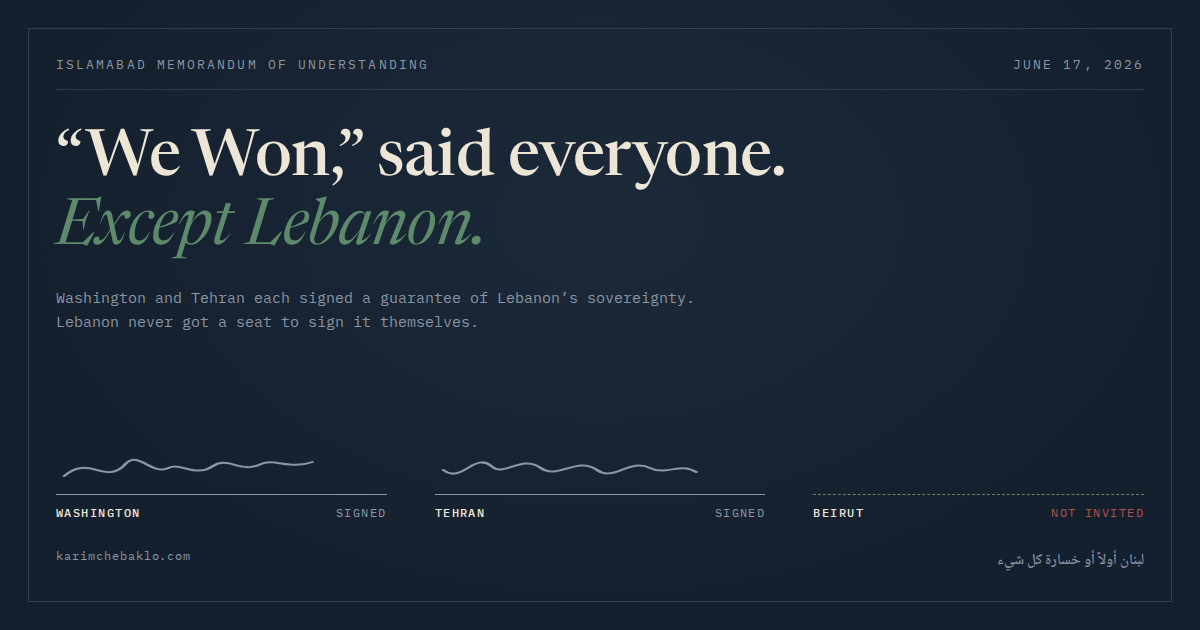
Here's the final draft, this is the current state of the file you'll publish.
Within a day of Donald Trump and Masoud Pezeshkian signing the Islamabad Memorandum of Understanding at Versailles, Israeli strikes continued hitting Lebanon. The same document that declares an "immediate and permanent termination of military operations on all fronts, including in Lebanon" was already being contradicted on the ground as the ink dried. That gap between the text and the territory is the whole story.
Iran's chief negotiator, Mohammad Bagher Ghalibaf, told Fars News the agreement was "a record of US failure." The Trump administration was telling reporters the opposite at the same hour, framing the same fourteen points as proof Iran had been brought to heel. Both governments walked out of Versailles calling it a win. Lebanon walked out with a signature it never got the chance to add.
What actually happened
On June 17, the United States and Iran signed a 14-point memorandum to end their war. Pakistan's prime minister signed as mediator. The first round of follow-up talks was due in Switzerland this Friday. Within 48 hours of the signing, that meeting was already in doubt, with Iran's foreign ministry citing Israel's ongoing campaign in Lebanon as the reason. A document meant to end a war could not survive 48 hours past the fighting it claimed to have ended. The deal reopens the Strait of Hormuz, lifts the US naval blockade on Iran, and starts a 60-day clock toward a final agreement that will eventually need a binding UN Security Council resolution.
Two versions of the text exist, one released by Washington and one by Tehran. They differ in tone but converge on the substance. Both name Lebanon. Both use almost identical language to guarantee its territorial integrity and sovereignty. Neither version has a Lebanese signature anywhere on it.
What Iran gets, on paper
The headline terms favor Iran heavily. The US commits to ending all sanctions, UN, IAEA, and its own unilateral measures, on a schedule still to be negotiated. It commits to a reconstruction fund of at least $300 billion, financed by "regional partners," not by Washington itself, since Trump has already said the US will not contribute directly. Frozen Iranian funds become usable again, payable to any beneficiary designated by Iran's central bank. There is no restriction in the text on what that money can be used for.
Iran's matching obligation is to freeze its nuclear program where it currently sits. Not to roll it back. Not to dismantle anything. Just hold.
Why the money may not move on schedule
None of this happens automatically. Under the Iran Nuclear Agreement Review Act, the president has five days to submit any Iran-related agreement to Congress, and a 30-day window opens during which he cannot waive statutory sanctions tied to that agreement. Whether this MOU even qualifies as the kind of agreement the law covers is already being argued by lawyers on both sides. Congress did not wait for that argument to resolve. Senator Bill Cassidy called the deal one of the worst foreign policy decisions in decades, and other Republican senators have raised their own concerns over cost and lost leverage. Democratic lawmakers have separately demanded a full accounting. The fight over delivery started before the ceremonial signatures were dry.
This is the part most coverage will get right: the paper terms favor Iran, and the delivery risk sits with the United States.
The channel less exposed to Congress
There is one piece of this deal that does not have to wait on the $300 billion fund or the frozen-asset dispute to start moving. Point 10 commits the US Treasury to issuing oil export waivers immediately upon signing. Iranian oil sanctions are themselves statutory, so a full and permanent removal still runs into the same congressional fight as everything else. But Treasury has already shown this year that it can issue narrower, temporary waivers on its own authority, separate from any new agreement, simply to manage global oil prices. Buyers responded cautiously to those earlier waivers, wary they could be reversed, so this channel is not unconstrained. It is just less exposed to a single congressional vote than the bigger, more contested numbers everyone is debating.
Iran's oil revenue dwarfs what it would take to keep its regional proxies funded. Hezbollah does not need a dedicated pipeline. It needs Iran's general budget to loosen by a fraction. Money is fungible, and nothing in this agreement earmarks where Iranian oil revenue, once it starts flowing again, has to go. That is a structural risk grounded in Iran's own funding history, not a claim that any transfer has already happened. But even a partial, cautious resumption of exports is likely enough, given how small Hezbollah's funding needs are next to Iran's total oil revenue. That is also the piece of this deal with the least oversight built into it.
Lebanon: guaranteed, not consulted
Lebanon is named twice in this document. It is promised territorial integrity. It is promised sovereignty. It is promised none of the $300 billion, none of the frozen-asset release, and no defined seat in the "implementation mechanism" set up to monitor whether any of this actually holds.
Some early reporting suggested Iran's text gave Lebanon stronger weight than the American one. That does not hold up against the final, officially released versions. Both texts say the same thing, almost word for word: the war ends on all fronts including Lebanon, and the parties guarantee its territorial integrity and sovereignty. Washington and Tehran agree on Lebanon. They just never asked Lebanon.
Pezeshkian posted the Persian text himself, calling it the product of "national steadfastness, political rationality and responsible diplomacy." A government can say that about its own sovereignty because it negotiated it. Lebanon cannot say the same thing about a guarantee written for it by two other capitals, in a document it never sat down to draft.
What this means for Lebanon
The clause's language reaches further than its signatures do. Point 1 names the United States, Iran, and "their allies in the current war" as the parties declaring the ceasefire, which textually sweeps Israel in as a US ally. But only Trump and Pezeshkian signed at Versailles, with Pakistan as mediator. Israel was not at that table and has been reported as shut out of the negotiations entirely. The document claims a scope on paper that it has no mechanism to actually bind. Within a day of the signing, Israeli strikes continued on Lebanese territory, exactly what you would expect from a party written into a declaration it never agreed to.
None of this means a ceasefire is bad for Lebanon. Fewer strikes are better than more, and ending a regional war removes one real source of risk to Lebanese territory. But that is a separate question from whether Lebanon's sovereignty was respected in how this was decided. A guarantee written by two outside capitals, about a country that did not sit at the table, is still a guarantee made without consent, even when the outcome it points toward, less fighting, is one Lebanon also wants.
Hezbollah's disarmament was never part of this negotiation, and the table just closed. Read all 14 points again. Hezbollah is not named once. Lebanon appears only as a front in the ceasefire clause. Point 13 limits all future talks to the remaining clauses of this same document: the nuclear file, the sanctions schedule, the reconstruction mechanism. Disarmament was never one of the original 14 points, so it has no path into what comes next either. The active US-Iran negotiation, the moment Lebanon's leverage argument has always pointed to, just produced a Hormuz reopening, a nuclear freeze, and a ceasefire, all without making Hezbollah's arms a condition of anything.
The financing risk flagged earlier lands at the worst possible time. If Iran's oil revenue resumes with no restriction on where it goes, the external pressure that was supposed to make Hezbollah's funding harder to sustain eases instead, right as Lebanon's domestic disarmament debate is at its most contested point.
That tradeoff is the real cost for Lebanon. Less regional war is genuine, short-term relief. But trading it for a Hezbollah that keeps its arms, and may find its financing easier rather than harder, is not a wash. It pushes the disarmament question further out while removing one of the few sources of real pressure, a financially squeezed Iran, that made raising it possible at all. A calm bought today at the price of a longer entrenchment is not a net gain. It is a deferred bill, and Lebanon does not get to choose when it comes due.
And Lebanon has no standing to invoke any of this. Not being a party means Lebanon cannot point to this memorandum in any forum and claim its sovereignty was violated under it. The guarantee is language in someone else's bilateral text. It creates no obligation Lebanon can enforce, only one Lebanon can hope others choose to honor.
A guarantee made by others, about you, without you, is not sovereignty. It is a line item.
لبنان أولاً أو خسارة كل شيء