Two Kinds of Injustice. One Disease.
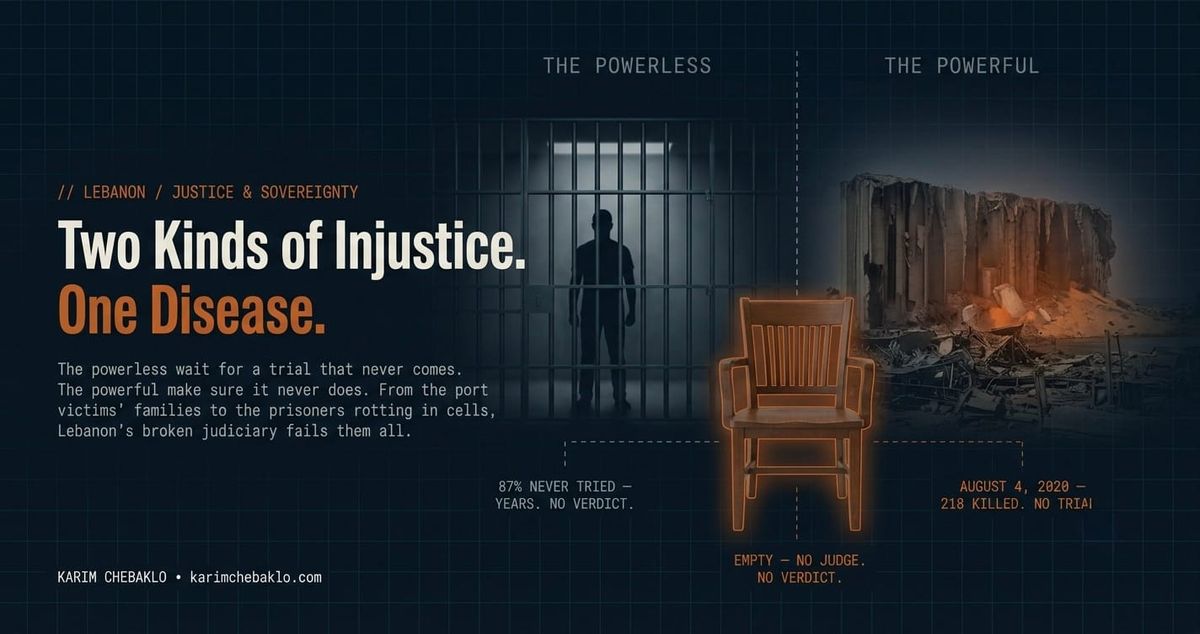
The powerless wait for a trial that never comes. The powerful make sure it never does. From the port victims' families to the prisoners rotting in cells, Lebanon's broken judiciary fails them all.
His name does not matter for this story, because the point is that nobody knows it. He has been sitting in Roumieh prison for years. He has never been convicted of anything. No verdict. No sentence. Just a file, a cell, and time that keeps passing. He is not an exception. He is the rule.
Eighty seven percent.
That is the share of people sitting in a Lebanese prison cell right now who have never been convicted of anything. Out of roughly 8,500 people held in Lebanese prisons today, in a system built to hold about 4,500, the overwhelming majority are waiting. Some have been waiting for over a decade.
This is not a story about overcrowding. Overcrowding is the symptom. The disease is that Lebanon has largely stopped judging its own citizens, and the political class has spent the last year arguing over how to release people it never bothered to try in the first place.
The numbers, plainly
Lebanon's prison population sits at roughly double its official capacity, a rate that reportedly hit 300 percent in parts of the system in early 2025, made worse when Israeli strikes destroyed six detention facilities in the south, in Nabatieh, Marjayoun, Tibnin, Bint Jbeil, Tyre, and Baalbek, and pushed those inmates into already packed prisons elsewhere.
The pretrial share has run as high as 87 percent in 2023, with more recent estimates in 2024 and 2025 still above 80 percent. Either number is an outlier by any global standard.
Nearly half the prison population is foreign, and this is worth being precise about. It is not that foreigners are driving crime in Lebanon. Close to 45 percent of all inmates are held specifically for immigration status violations, entering or overstaying illegally, not for a violent or property offense. A Lebanese citizen cannot be jailed for existing without the right paperwork. A Syrian or an Ethiopian domestic worker can. That distinction alone explains a large share of the foreign prisoner count, and it is a very different problem from the one usually implied.
Here is the number that should reframe the entire debate: Lebanon's incarceration rate, at 141 people per 100,000, sits almost exactly at the global average. Lebanon does not lock up an unusual number of people. It locks up a normal number of people and then cannot process them. Compare that to a country like El Salvador, north of 1,000 per 100,000, or Japan, under 40. Lebanon is not an outlier on how many people it arrests. It is an outlier on what happens after the arrest, which is nothing.
The state's own investment in these people has collapsed along with everything else. According to Amnesty International, the real value of the Interior Ministry's prison medical budget fell from $7.3 million in 2019 to $628,000 in 2022. Prisoners are dying of tuberculosis in a country that used to have a functioning healthcare system. In 2018, more than 800 prisoners were transported to hospitals for medical care. By 2022 that number had fallen to 107, while the prison population remained roughly the same size.
The amnesty is not a justice measure. It is a sectarian ledger.
For over a year, parliament has tried and failed to pass a general amnesty law. Every time it gets close, it collapses, because it was never designed as a justice reform. It was designed as a political trade.
Sunni political blocs have pushed for the release of roughly 350 Islamist detainees, many held for over a decade without trial since the Fatah al-Islam and ISIS era arrests. Shiite blocs have pushed to include drug offenders from the Baalbek-Hermel region. Christian blocs have used the same bill to push for the return of people linked to the South Lebanon Army who fled to Israel in 2000. None of these categories were selected because a judge reviewed the evidence. They were selected because a sect wanted its people back.
This is the part that should bother anyone who cares about sovereignty. An amnesty of this kind is not the state exercising justice. It is the state outsourcing the question of guilt and innocence to sectarian negotiators, the same way it outsources so much else. A sovereign country decides who is guilty through its courts. Lebanon has been trying to decide it through a parliamentary bargain instead, one seat at a time.
The courts are not broken by accident
The obvious question is why, if the problem is that nobody gets tried, the answer is not simply to try them. It should be. The honest answer to why that has not happened is not that Lebanon lacks the capacity. It is that the political class has spent years making sure the judiciary stays too weak to act independently, because a weak judiciary is one they can still control.
A Lebanese judge earned around $4,000 a month in 2019. Today that salary is worth about $50. Courtrooms have run without electricity, without paper, without basic supplies. A judicial independence law finally passed in July 2025, after years of delay, but human rights monitors and the Lebanese Judges Association both said it fell short, since it still allows the government-appointed top prosecutor to order other prosecutors to halt ongoing cases, and it still leaves judicial appointments open to political gridlock. A separate draft law meant to strengthen the judiciary's independence was sent to parliament in 2025 and simply never scheduled for debate.
This is not a state that tried to fix its courts and failed. It is a state that has repeatedly chosen not to.
What should actually happen
Lebanon holds nationwide parliamentary elections in a single day. Polling stations open, ballots are printed, votes are counted, and by the next morning the country has an answer. That is a logistics operation the state can clearly execute when it decides to.
The man in Roumieh who has been waiting for years does not need the full machinery of a complex trial. He needs someone to open his file. In 2023, when security conditions made it difficult to transport detainees to courthouses, Lebanese courts were instructed to fast track release requests. Judges worked through backlogs. Files were reviewed. Some people who had no business being in a cell went home. It worked, imperfectly and partially, but it worked. The state knew how to do it. It chose to stop.
A national judicial mobilization, dedicated sessions, extra staffing, a firm public deadline, could review every pretrial file in the country and immediately release or dismiss the ones that do not meet a legal threshold. For the remaining cases, the ones with real evidence and real charges, the answer is not a rushed verdict. The answer is a fixed public deadline and dedicated fast track courts assigned specifically to clear the backlog. Still a real trial. Still a real verdict. Just one that happens in months rather than years.
That is the sovereign version of solving this crisis. Not a bill that trades a detainee from one sect for a detainee from another. A court that does its job, on a deadline the country can see.
Six years, and counting
If you want to understand what it actually costs to have no functioning judiciary, consider what happened on August 4, 2020, and what has not happened since.
Hundreds of tons of ammonium nitrate that sat unguarded in the Port of Beirut for years detonated in one of the largest non-nuclear explosions in history. At least 218 people were killed. Thousands were wounded. Half the capital was damaged. Six years later, there has still been no trial.
The investigation alone took over five years, passed between two judges, was frozen for more than a year after political figures filed lawsuits against the man leading it, and was set back further when a senior judicial official among those implicated ordered the release of everyone detained in the case and pressed charges against the investigating judge for doing his job. The file was finally closed this past March, with around seventy people implicated. It now sits with a prosecutor general, waiting for the next procedural step before an indictment can even be issued. There is still no trial date.
Sit with this alongside the 87 percent. The anonymous man in Roumieh cannot get in front of a judge because the state has left him to rot in a system with no functioning docket. Seventy of the most powerful people in the country cannot get in front of a judge either, because they have spent six years using every lever of political power to make sure they never have to. The powerless and the powerful in this country cannot face a judge, for exactly opposite reasons. One is failed by a state too broken to try him. The other is protected by a state too captured to try them.
That is not a coincidence. It is the same disease. A country that wants to call itself sovereign has to be able to do one basic thing: put its own citizens, whoever they are, in front of its own courts, and let the law decide. Lebanon has not done that for the man with no name in Roumieh. It has not done that for the families still waiting outside the port, six years on.
To the 218 who did not survive the fourth of August, and to the families who have spent six years asking a state to do the one thing a state is supposed to do: this is still owed to you.
لبنان أولاً أو خسارة كل شيء