Disarm Hezbollah With What Army? The Missing Conversation
In 2000, Israel withdrew from Lebanon. As part of that withdrawal, the Lebanese state accepted a structural limitation: keep the Lebanese army disarmed enough that it could never threaten Israeli territory. For 26 years, this constraint held. The Lebanese army was permitted to exist, but not to build the capacity that would make it a match for an armed Hezbollah.
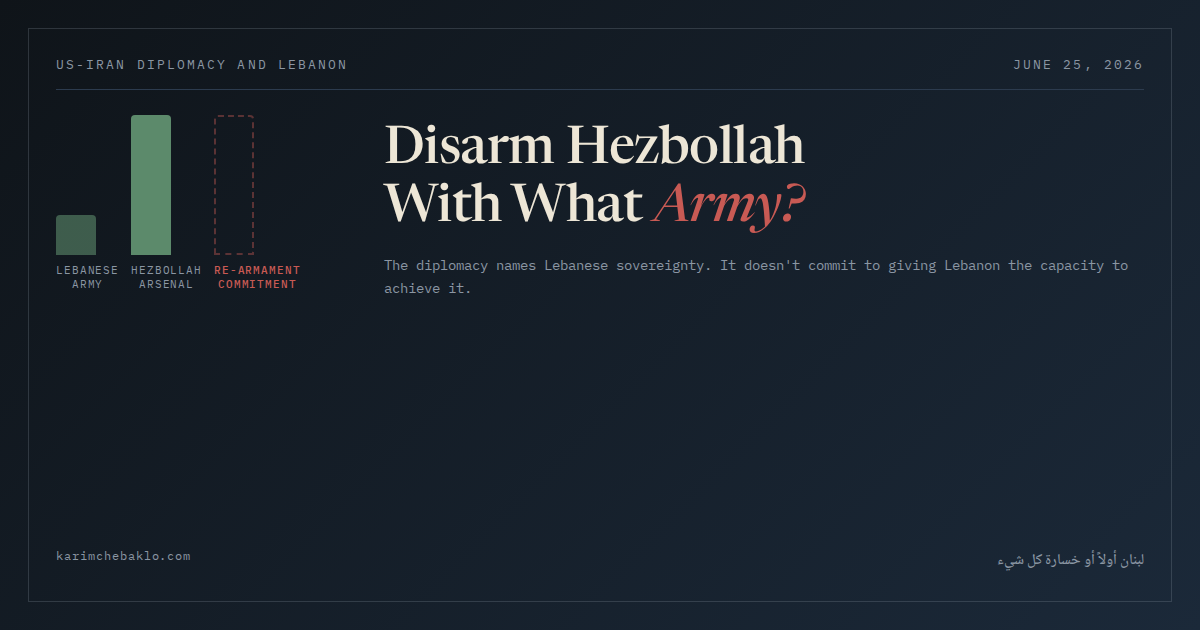
Today, as Secretary of State Marco Rubio shuttles between Gulf capitals and US-mediated talks resume in Washington, the same negotiators are asking that same, intentionally weakened army to do the one thing it was designed never to be capable of doing: disarm Hezbollah.
That contradiction is the entire story. It is also the evidence that none of the current parties are actually committed to what they say they want.
THE CONSTRAINT: HOW LEBANON'S ARMY BECAME INTENTIONALLY INSUFFICIENT
When Israel withdrew in 2000, Lebanon did not gain the right to a fully capable military. It gained the right to a constrained one. UN Resolution 1701 (2006) later codified what was already understood: Lebanese armed forces south of the Litani River, but with restricted capabilities. Not a force designed to project power or challenge a rival actor on Lebanese soil. A force designed to police.
The arithmetic is stark.
Lebanese military annual budget: roughly $600-800 million. Hezbollah annual budget, Iran-financed: estimates range from $700 million to $1+ billion annually, covering operational expenses alone, not counting the value of Iranian arms transfers. Add 26 years of continuous Iranian investment, and Hezbollah's military capacity, intelligence apparatus, supply lines, and command structure have no Lebanese state equivalent.
Personnel numbers: Lebanese army in the south, roughly 5,000. Hezbollah fighters, estimated at 130,000 to 150,000, with organizational depth, ideological cohesion, and external strategic backing.
Capability gap: Hezbollah possesses sophisticated anti-tank weapons, precision-guided missiles, drone capabilities, and command-and-control systems. The Lebanese army operates with chronic shortages of spare parts, limited air defense, and equipment that predates the modern era.
This was not accidental. It was intentional policy, accepted by Lebanese governments, enforced by Israeli insistence, and later managed by international arrangement. The Lebanese state was permitted to exist in the south, but only as a weaker actor than the armed group operating within its territory.
For 26 years, this constraint held.
THE IMPOSSIBLE ASK: NOW THEY WANT THE WEAK ARMY TO WIN
The US-Iran Memorandum of Understanding, signed June 17, frames the Lebanon question simply: "immediate and permanent termination of military operations on all fronts, including in Lebanon" and "ensuring the territorial integrity and sovereignty of Lebanon."
The subsequent diplomacy frames the path even more simply: Lebanese army takes control of southern territory, disarms Hezbollah, and the Lebanese state recovers its monopoly on force.
Listen to how this is described by the negotiators.
Secretary of State Marco Rubio, currently on a Gulf tour to reassure allies about the MOU: "The more of that area the Lebanese Armed Forces is able to secure, the less of it's in Hezbollah's control, the less Israel will be in Lebanon." Simple. Clean. Implies a straightforward military outcome.
The fifth round of Israel-Lebanon talks, happening right now in Washington: focus on creating "pilot areas" in southern Lebanon from which Israeli forces would withdraw, allowing Lebanese military forces to take their place and disarm Hezbollah operatives. The implicit assumption: Lebanese forces have the capacity to do this.
Lebanese President Joseph Aoun, in cabinet meetings: "We are heading into a new round that we hope will be decisive on the path to accomplishing what we want for the good of our country and people." The desire is stated. The capacity is assumed.
But capacity and desire are not the same thing.
No one is proposing to actually re-arm the Lebanese state first. There is no new military aid package that would upgrade Lebanese capabilities to anything approaching parity with Hezbollah. There are no plans to fundamentally restructure Lebanese military procurement, training, or command hierarchy. The diplomatic framework is asking Lebanon to win a fight using the same tools it was deliberately prevented from being capable enough to win.
WHAT WOULD ACTUALLY WORK (AND WHY IT'S NOT BEING PROPOSED)
If the goal is genuine Hezbollah disarmament and Lebanese sovereignty without Iranian interference, here is the concrete roadmap:
Phase One: Lebanese State Capacity Building (12-18 months)
The Lebanese army must be re-armed and restructured to be a genuine military match for Hezbollah, not a constabulary force. This requires:
- Full upgrade of Lebanese military procurement: air defense, armor, artillery, precision-strike capability, intelligence systems. Not modest improvements. Capability parity with a 130,000-strong armed group that has been funded at $1+ billion annually for 26 years.
- International training mission: US, European, and allied military advisors embedded in Lebanese command structure for at least two years, restructuring chains of command and operational doctrine.
- Security guarantees: Written commitment from the US and international partners that any Iranian attempt to resupply Hezbollah or Iranian IRGC presence in Lebanon triggers automatic military response. Not diplomatic pressure. Military response.
- Parallel Iranian withdrawal: Simultaneous removal of IRGC personnel, intelligence operatives, and supply infrastructure from Lebanese territory, verified by international inspection teams with enforcement authority.
Cost estimate: $2-4 billion in military aid alone, plus sustained annual funding for Lebanese state institutions.
Phase Two: Disarmament Enforcement (6-12 months)
Once Lebanese state capacity is established:
- Hezbollah given a defined surrender period for weapons and command structures. Not indefinite. Defined.
- Mandatory dismantling of Hezbollah military command hierarchy, not absorption into political structures. Actual disarmament, not rebranding.
- International peacekeeping force (beyond UNIFIL) to enforce the disarmament and monitor the Iranian border, with rules of engagement that include interception of supply convoys.
- Criminal accountability process for command figures involved in attacks on civilians or Israeli territory.
Phase Three: State Consolidation (24+ months)
- Lebanese government assumes monopoly on force south of the Litani River
- Reconstruction funding tied to verifiable disarmament and absence of non-state armed groups
- Regional security architecture that prevents future Iranian military buildup in Lebanon
WHERE THE CURRENT DIPLOMACY DIVERGES
On Lebanese army rearmament: Nothing. Rubio's message focuses on what Lebanese forces "are able to secure," but there is no US commitment to actually upgrade Lebanese military capability. The talks focus on Lebanese forces taking territory, not on giving them the weapons to hold it against a superior force. Budget allocations show this: the proposed $300 billion reconstruction fund is for Iran. Lebanon gets no equivalent military aid package.
On Iranian withdrawal: Silence. Iran's Foreign Minister Abbas Araghchi says any Israeli forces remaining in southern Lebanon would constitute a violation of the MOU, but there is no parallel demand for Iranian IRGC withdrawal or removal of Iranian supply lines. The MOU names Lebanon's sovereignty, but only ties it to Israeli behavior, not Iranian behavior. Iran's role in Lebanon is left completely unaddressed in the enforcement mechanism.
On security guarantees: Nothing binding. Rubio spoke to Lebanese President Aoun about "bilateral negotiations with Israel" as "the only feasible path," but there are no written guarantees that Iran cannot simply re-fund Hezbollah once the initial ceasefire ends or sanctions relief begins flowing. No enforcement mechanism. No tripwire that automatically triggers a response if Iran restocks Hezbollah's arsenal.
On disarmament timeline: Undefined. The talks focus on "pilot areas" where Lebanese forces take control, but there is no stated deadline for Hezbollah to surrender its arms, no enforcement mechanism if it refuses, and no consequence built into the MOU if disarmament stalls indefinitely. The timeline is open-ended, which means it can be extended, delayed, or abandoned without triggering any automatic response.
On funding allocation: The $300 billion is for Iran. Lebanese state capacity building is not funded at scale. Lebanon is being asked to win a military contest it has no resources to win, while the other party is receiving massive financial injection to rebuild its military-industrial base.
WHAT THIS ABSENCE TELLS YOU
The roadmap above is what actual disarmament and Lebanese sovereignty would require. None of it is being proposed. Not because it is impossible, but because none of the current parties are willing to commit to it.
- The US is not committing to re-arm Lebanon beyond current modest levels
- Iran is not agreeing to withdraw from Lebanon
- Israel is not agreeing to a timeline for withdrawal in parallel with Lebanese state capacity building
- Lebanon is not being given the resources to actually enforce disarmament
What is being negotiated is:
- A ceasefire that freezes territorial positions
- Lebanese state "pilot zones" that give the appearance of state authority without the firepower to maintain it
- A sanctions relief and reconstruction package for Iran that may actually ease its ability to sustain Hezbollah's funding
- A diplomatic framework where Lebanon's sovereignty is named but not resourced
The absence of these concrete steps is not a gap in the diplomacy. It is the point of the diplomacy.
If the goal were actually Hezbollah disarmament and Lebanese sovereignty, the first conversation would be about Lebanese rearmament. Not as an afterthought. As the foundation. Before pilot zones, before timelines, before any talk of disarmament enforcement.
That conversation is not happening. Which tells you what is actually being decided in Washington and Geneva: not whether Lebanon will be sovereign, but what form Lebanese dependence will take.
Lebanon is being offered a choice between being occupied by Israel or being controlled by Iran. The current diplomacy is trying to make that look like a choice between "regional stability" and "chaos." It is not. It is a choice between two forms of subordination, dressed up as a diplomatic opportunity.
The trap that was set in 2000 — an army too weak to defend Lebanese sovereignty against internal armed groups — is still in place. The negotiators are now pretending that same weak army can solve the problem that weakness created.
Read what they are committing to. Read what they are not committing to. Read what stays undefined.
Then ask yourself: if the goal were actually Hezbollah disarmament, why are we not talking about re-arming Lebanon?
لبنان أولاً أو خسارة كل شيء